

Why Your Shopify Store Needs Regular TLC
Shopify website maintenance is the ongoing process of monitoring, updating, and optimizing your online store to ensure peak performance, security, and customer experience. Just like a car needs winter tires for a trip up the canyon, your Shopify store requires consistent care to run smoothly and avoid costly breakdowns, especially in Utah’s dynamic market.
Essential Shopify website maintenance tasks include:
- Security updates – Keep themes, apps, and plugins current to prevent vulnerabilities
- Performance monitoring – Ensure fast loading speeds (under 3 seconds) to avoid losing 40% of visitors
- Regular backups – Protect your store data from crashes or security breaches
- Content updates – Keep product information, policies, and content fresh
- SEO optimization – Monitor keyword performance and fix broken links
- User experience testing – Check forms, checkout process, and mobile responsiveness
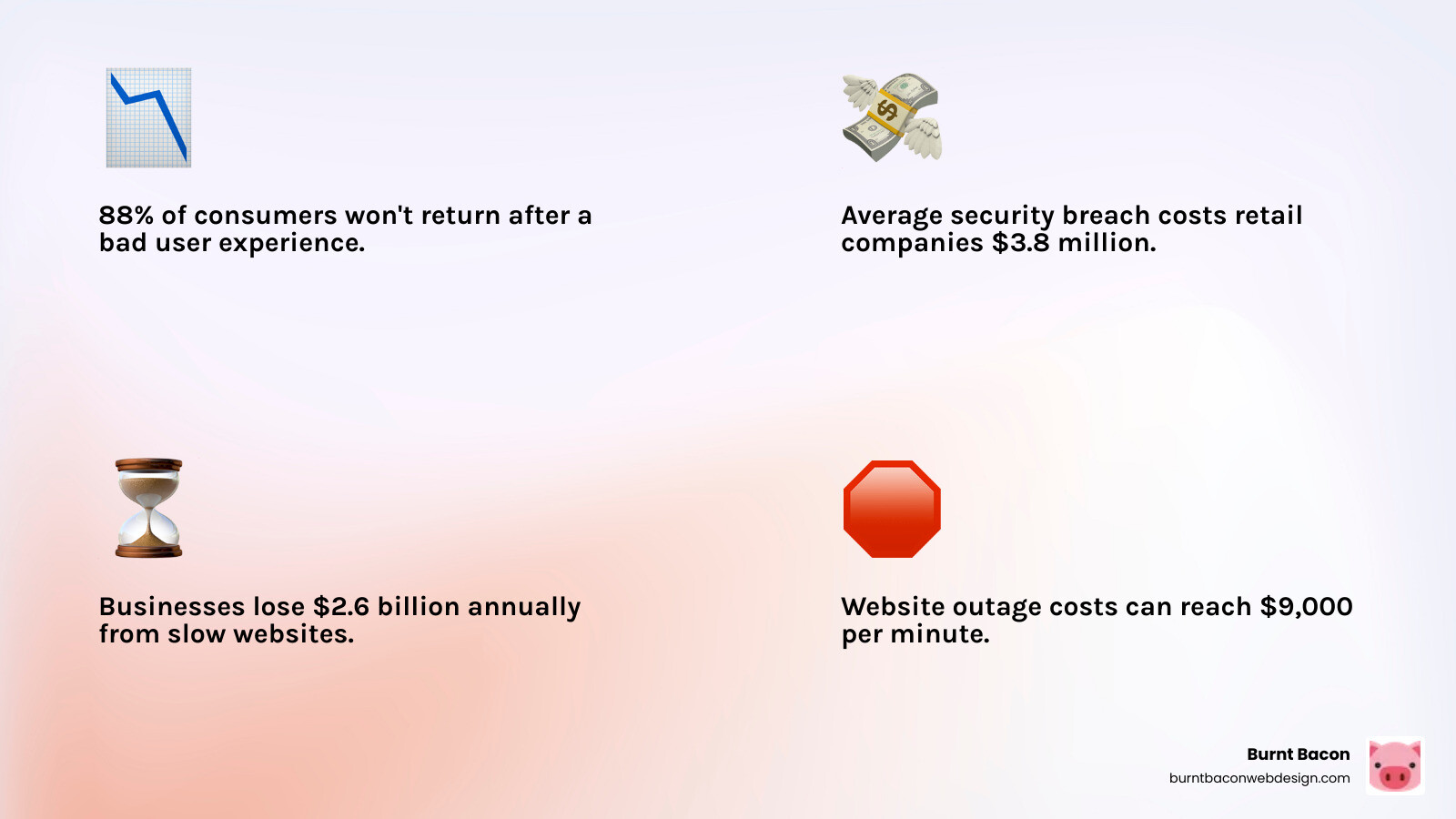
For a business based in Salt Lake City or South Jordan, the consequences of neglecting maintenance can be severe. Research shows that 88% of consumers won’t return to a site after a bad user experience, and the average cost of a security breach for retail companies is $3.8 million. Meanwhile, businesses lose $2.6 billion annually due to slow-loading websites.
Managing a Shopify store is similar to taking care of a car – ignore regular maintenance now, and you’ll pay double later through lost sales, security issues, and damaged brand reputation.
I’m Craig Flickinger BB, founder of Burnt Bacon Web Design, with over 10 years of experience helping Utah businesses optimize their online presence and Shopify website maintenance strategies. After my career at Hewlett-Packard and a web hosting company, I’ve seen how proactive maintenance separates thriving stores from struggling ones.
What is Shopify Website Maintenance and Why It’s Crucial for Utah Businesses
Think of Shopify website maintenance as the behind-the-scenes work that keeps your online store humming along smoothly. It’s the proactive care that prevents small hiccups from becoming major headaches – kind of like changing your car’s oil before the engine seizes up.
Proactive maintenance means staying ahead of problems rather than scrambling to fix them after they’ve already cost you sales. This includes keeping your themes updated, monitoring your site’s speed, backing up your data regularly, and ensuring everything works perfectly for your customers.
Here’s where it gets interesting: Shopify operates on what’s called a shared responsibility model. As a Software-as-a-Service (SaaS) platform, Shopify handles the big infrastructure stuff – servers, core security, and platform updates. But you, the merchant, are responsible for everything you build on top of that foundation. Your theme, your apps, your content, and most importantly, your customer’s experience.
This is actually great news because it gives you control over what matters most to your business. But it also means you can’t just “set it and forget it.”
When Utah business owners neglect their Shopify website maintenance, the consequences pile up fast. Lost traffic happens when search engines notice your site is slow or buggy – they’ll push you down in rankings faster than you can say “organic search results.” Poor customer experience is even worse because 88% of consumers won’t return after a bad user experience.
The numbers tell a sobering story. Businesses lose $2.6 billion annually due to slow-loading websites. The average cost of a security breach for retail companies hits $3.8 million. Website outages cost nearly $9,000 per minute, and over 18 million websites get infected with malware each week.
For businesses in Salt Lake City, South Jordan, and across Utah’s competitive market, these aren’t just statistics – they’re potential business killers. When a customer in Park City tries to buy from your store and encounters broken links or slow loading times, they’re just one click away from your competitor.
That’s why we focus on building robust foundations with our Ecommerce Website Design Utah services. A well-maintained Shopify store isn’t just about avoiding problems – it’s about creating a competitive advantage that keeps Utah customers coming back.
Your Essential Shopify Website Maintenance Checklist

Creating a solid Shopify website maintenance routine is like grabbing coffee from your favorite local spot in South Jordan before heading to the office – it might seem like extra work at first, but once it becomes a habit, your day (and your store) runs so much smoother. The key is being proactive rather than reactive, catching small hiccups before they turn into major headaches that cost you customers and sleep.
A well-maintained store doesn’t just prevent problems – it actively supports your business growth. When your site loads quickly, functions flawlessly, and provides an excellent user experience, you’re setting the stage to Open up Higher Conversions: Best Practices for CRO Success. Let’s break down your maintenance tasks by frequency to make this manageable.
Weekly & Monthly Tasks: The Core Upkeep
Think of these tasks as your store’s daily vitamins – small but essential actions that keep everything running smoothly and your customers happy.
Regular backups are your digital insurance policy. While Shopify handles platform-level backups, you’re responsible for your store’s specific data under their shared responsibility model. Shopify’s manual backup options are pretty limited – you can download CSV files for products, customers, and orders, but that’s about it. For real peace of mind, invest in a dedicated backup app like Rewind, Talon Backups, or BackupMaster Backups. Set these to run automatically so you never have to worry about losing your hard work.
Theme and app updates might seem tedious, but they’re crucial for keeping your store secure and running smoothly. Your theme is literally the face of your business, and developers constantly release updates to fix bugs, boost performance, and add new features. Similarly, outdated apps can create security vulnerabilities or conflicts that slow down your site. Just like updating apps on your phone, make checking for Shopify app updates a regular habit.
Here’s a sobering fact: 40% of users will abandon a site that takes more than three seconds to load. That’s why page speed checks need to be on your regular to-do list. Use tools like Google PageSpeed Insights or GTmetrix to monitor your loading times. A one-second delay can lead to 11% fewer page views and a 7% loss in conversions – that’s real money walking out the door.
Mobile responsiveness testing is non-negotiable in today’s world. With over half of web traffic coming from mobile devices, your Utah customers are probably browsing your store while waiting for a TRAX train in Salt Lake City or during their lunch break in South Jordan. Test your site regularly on different devices to ensure it looks and works perfectly everywhere.
Don’t forget about broken link scanning and form testing. Nothing kills a sale faster than a customer clicking a link that goes nowhere or trying to checkout only to hit a glitchy form. These small technical issues can make your professional business look amateur, especially in competitive markets like Salt Lake City.
Quarterly Tasks: The Strategic Review
Every quarter, it’s time to step back and look at the bigger picture – like reviewing your business finances, but for your website’s health and performance.
Your SEO audit is where you get to play detective with your store’s search performance. Are you ranking for the right keywords? What are potential customers in Utah actually searching for when they need your products? Review your keyword performance and update your content accordingly. Our guide on Website Traffic and Sales: What Affects Organic Keyword Search? can help you dig deeper into this.
Content freshness matters more than you might think. Outdated product descriptions, stale blog posts, or old meta descriptions can make your store feel neglected. Plus, search engines love fresh, relevant content. Take time to update your About Us page, refresh product descriptions, and ensure your meta descriptions accurately reflect what customers will find.
A user experience flow review means putting on your customer hat and shopping your own store. Start from your homepage and go all the way through checkout. Is the journey intuitive? Are there confusing steps? 23% of people who have a positive user experience will tell ten or more people about it – that’s powerful word-of-mouth marketing.
Don’t skip the security scans and user permission audits. While Shopify handles platform security, you want to make sure your custom code and third-party apps aren’t creating vulnerabilities. Also, if you have multiple staff members with access to your store, regularly review who can do what to prevent accidental changes.
Finally, dive deep into your analytics review using both Shopify Analytics and Google Analytics. This data tells the real story of how your store is performing and where you should focus your efforts next.
Annual Tasks: The Big Picture
Once a year, it’s time for the equivalent of a comprehensive physical exam for your store – a thorough check-up that ensures you’re ready for whatever the next year brings.
Your full website audit is the granddaddy of all maintenance tasks. This means examining every aspect of your store: design, functionality, performance, SEO, security, and content. It’s like spring cleaning, but for your digital storefront. This audit often reveals opportunities for significant improvements or identifies when it might be time for a major refresh.
Legal policy updates might not be exciting, but they’re essential. Laws change, especially around privacy and e-commerce, and you need to stay compliant. Update your Privacy Policy, Terms of Service, and other legal pages to reflect current requirements – this is particularly important if you’re serving customers beyond Utah.
Competitor analysis gives you a reality check on where you stand in the market. What are other businesses along the Wasatch Front doing well? Where are they falling short? This intelligence can reveal new opportunities for your store to shine.
Finally, use your annual review to plan for major redesigns or feature rollouts. Based on everything you’ve learned from your audit and business performance, you might decide it’s time for significant changes. If you’re considering major custom development work, check out the 7 Advantages of Investing in Custom Shopify Development Services to understand your options.
Shopify website maintenance isn’t just about preventing problems – it’s about positioning your store for success in Utah’s competitive market and beyond.
Decoding the Costs: Budgeting for Shopify Maintenance

Let’s be honest – nobody loves talking about budgets. But when it comes to Shopify website maintenance, understanding the costs upfront can save you from those heart-stopping moments when something breaks at 2 AM on Black Friday.
Think of it like this: you wouldn’t buy a car and never change the oil, right? The same principle applies to your online store. The question isn’t whether you’ll spend money on maintenance – it’s whether you’ll spend a little now or a lot later when things go sideways.
Several key factors determine what you’ll invest in keeping your store running smoothly. Store complexity plays a huge role – a simple boutique in Salt Lake’s 9th and 9th district needs far less attention than a sprawling outdoor gear marketplace catering to all of Utah’s adventurers. Customization level matters too. If your store has unique functionality or heavily modified themes, you’ll need specialized care that costs more than basic maintenance.
The number of apps you’re running also impacts your budget. Each app is like adding another appliance to your home – more things that can break and need updates. And here’s something many Salt Lake City and South Jordan business owners don’t consider: your time has value. You could handle maintenance yourself, but those hours spent troubleshooting could be better spent growing your business.
When you’re weighing your options, it helps to understand the typical cost ranges. DIY maintenance might only cost you app subscription fees (usually under $100 monthly), but you’re trading money for your precious time and peace of mind. Basic professional maintenance typically runs $100 to $500 per month and covers essential tasks like backups, updates, and basic security checks. Advanced maintenance plans range from $500 to $3,000+ monthly, a necessary investment for a growing South Jordan tech accessory brand competing nationally, offering everything from performance optimization to strategic consulting and custom development support.
Here’s what makes Shopify brilliant for Utah businesses: the platform dramatically reduces your Total Cost of Ownership compared to other solutions. While you’re focusing on maintenance costs, Shopify is quietly handling hosting, security updates, and platform maintenance that would cost thousands on other platforms. Independent research shows Shopify’s competitors typically cost 30% more for the platform itself and 23% more to operate – that’s up to 36% savings you can reinvest in growing your business.
This cost advantage is especially important for businesses in Salt Lake City and across Utah, where every dollar counts toward building a competitive edge. We’ve seen how this impacts local businesses, which is why we explored this topic thoroughly in our comparison guide: Shopify vs WordPress: Which is Better for Utah Businesses?.
The bottom line? Shopify website maintenance is an investment, not an expense. A well-maintained store converts better, ranks higher in search results, and builds customer trust – all of which directly impact your revenue. The key is finding the right balance between cost and coverage that fits your business needs and growth goals.
DIY vs. Hiring a Pro: Making the Right Choice for Your Business
The question of handling Shopify website maintenance yourself versus bringing in professionals isn’t just about money—it’s about understanding where your energy creates the most value for your business. Think of it this way: you could learn to fix your own car, but is that really the best use of your time when you could be focusing on growing your customer base?
The DIY Approach to Shopify website maintenance
Rolling up your sleeves for Shopify website maintenance can feel empowering, especially for a startup bootstrapping out of a garage in South Jordan while watching every penny.
The cost savings are immediately obvious—you’re investing time instead of cash, which can be a lifesaver for new businesses. There’s also something satisfying about having direct control over every aspect of your store. Want to update that product description at midnight? No problem. Need to fix a broken link right now? You’re on it.
The learning curve becomes your friend here. Every task you tackle teaches you more about how your Shopify store works, making you more confident in making quick decisions and handling minor hiccups.
But let’s be honest about the challenges. The time commitment is real—and it’s ongoing. Every hour you spend updating apps is an hour not spent networking at a Salt Lake Chamber event, perfecting your product, or talking to customers. The risk of errors keeps many business owners up at night. Without specialized knowledge, a simple theme update could accidentally break your checkout process during your busiest sales period.
There’s also the limited scope issue. You might not know about the latest SEO techniques or security best practices that could give your store a competitive edge.
If you’re committed to the DIY path, the Shopify App Store offers helpful tools for backups, SEO, and speed optimization. The Shopify Help Center and Community forums are treasure troves of troubleshooting advice. For those just getting started, our guide on How to Start a Shopify Store provides a solid foundation.
When to Hire a Shopify Maintenance Service
For many Utah businesses ready to scale, partnering with a professional Shopify website maintenance service transforms from an expense into a strategic investment.
Expertise is the game-changer here. Professionals live and breathe Shopify updates, security threats, and performance optimization. They know which app combinations cause conflicts and how to squeeze every bit of speed from your site. This knowledge comes from managing dozens or hundreds of stores, not just learning on your own.
Time savings might be the most valuable benefit. When you’re not worried about whether your backup ran correctly or if that new app is slowing down your site, you can focus entirely on what makes your business unique—your products, your customers, your growth strategy.
Proactive solutions separate good maintenance services from great ones. Instead of just fixing problems after they happen, professionals monitor your site constantly, catching issues before your customers ever notice them. They implement preventative measures that keep small problems from becoming expensive disasters.
The peace of mind factor can’t be overstated. Knowing your store is in capable hands lets you sleep better, especially during busy seasons or when you’re traveling.
For stores requiring complex custom development or advanced troubleshooting, professional services—particularly those with dedicated Shopify Plus developers—can handle challenges that would take you weeks to figure out.
At Burnt Bacon, we understand the unique challenges facing Utah businesses. Our local expertise means we’re familiar with seasonal trends, local competition, and the specific needs of businesses serving customers from Salt Lake City to St. George. We offer comprehensive support that keeps your Shopify store performing at its peak, so you can focus on what you do best—running your business.
Frequently Asked Questions about Shopify Website Maintenance
We get these questions all the time from Utah business owners, and honestly, they’re great questions! Shopify website maintenance can feel overwhelming at first, but once you understand the basics, it all makes sense.
What happens if I don’t maintain my Shopify site?
Think of your Shopify store like your car – ignore the maintenance, and you’re heading for trouble. The consequences start small but snowball quickly into major headaches.
Decreased performance hits first. Your site starts loading slower, and customers get impatient. Research shows that a one-second delay in website loading can result in a 7% loss in conversions. For a business in Salt Lake City, that could mean dozens of lost sales during the holiday ski season. That’s real money walking out the door.
Security vulnerabilities are the silent killer. Outdated themes, apps, or custom code create entry points for hackers. We’re not talking about minor inconveniences here – the average cost of a security breach to retail companies is a staggering $3.8 million. Imagine your South Jordan-based store’s customer data being compromised; the damage to your local reputation would be immense and could shut down your store for days.
Your user experience suffers too. Broken links, forms that don’t work, and pages that look terrible on mobile devices frustrate customers. Here’s the kicker: 88% of consumers won’t return to a site after a bad user experience. One bad visit, and they’re gone forever.
Lower search rankings follow naturally. Google and other search engines penalize slow, insecure, and poorly maintained websites. Your visibility drops, making it harder for new customers to find you organically.
All of this adds up to lost sales and damaged brand reputation. Businesses lose $2.6 billion annually due to slow-loading websites alone. A neglected website makes your business look unprofessional and untrustworthy – not exactly the impression you want to make on potential customers in competitive Utah markets.
How often should I back up my Shopify store?
For active stores, we recommend daily or weekly backups using a reliable third-party app. I know it sounds excessive, but here’s the thing – Shopify operates on a shared responsibility model. They protect their platform, but your specific store data is ultimately your responsibility.
Think of backups as insurance for your digital business. You hope you’ll never need them, but you’ll be incredibly grateful if disaster strikes. We’ve seen too many business owners learn this lesson the hard way.
Always perform a backup before any major changes. Installing a new theme? Back up first. Adding a crucial app or making significant product updates? Back up first. It takes five minutes and could save you weeks of reconstruction work.
The good news is that quality backup apps like Rewind make this process automatic. Set it up once, and forget about it – until you need it.
Does Shopify handle all the security for my store?
This is probably our most common misconception! Shopify does handle platform-level security brilliantly. They manage server infrastructure, payment processing (they’re PCI DSS compliant), and network security. It’s one of their biggest advantages over self-hosted solutions.
But here’s what many Utah business owners don’t realize – you’re responsible for your store’s specific security configuration. This includes using strong passwords and enabling two-factor authentication for all staff accounts. We can’t stress this enough: weak passwords are like leaving your front door open uped.
Managing staff permissions is crucial too. Only give team members access to what they absolutely need. That seasonal helper you hired for the Sundance rush in Park City doesn’t need admin rights to your entire store.
Third-party apps require careful vetting. While Shopify reviews apps in their store, you need to understand what permissions you’re granting and stick with reputable developers. Every app you install is another potential entry point.
Don’t forget about data backups – as we covered above, this falls squarely on your shoulders. Shopify has system-level backups, but you need your own copies of critical store data.
Finally, stay vigilant against phishing attempts. Scammers regularly try to trick store owners into revealing login credentials through fake emails that look like they’re from Shopify.
The bottom line? Shopify provides an incredibly secure foundation, but your active participation in maintaining your store’s security is absolutely essential for complete protection.
Conclusion: Keep Your Shopify Store Thriving with Proactive Care
Think of Shopify website maintenance as an investment in your business’s future, not just another item on your to-do list. Every backup you create, every app you update, and every speed test you run is like putting money in the bank. The difference is, this investment pays dividends in happy customers, higher search rankings, and increased sales.
A healthy website equals happy customers – it’s that simple. When your Shopify store loads quickly, functions smoothly, and provides a seamless shopping experience, customers notice. They’re more likely to complete their purchases, return for future orders, and recommend your business to friends and family.
For Utah businesses, particularly those in Salt Lake City and South Jordan, a well-maintained Shopify store gives you a real competitive edge. While your competitors might be cutting corners on maintenance, you’ll be providing the kind of polished, professional experience that builds lasting customer relationships. In today’s digital marketplace, that attention to detail can make all the difference between a customer choosing you or scrolling past to the next option.
The beauty of proactive maintenance is that it prevents those middle-of-the-night panic calls about your website being down or hacked. Instead of scrambling to fix problems after they’ve already cost you sales and damaged your reputation, you’re staying ahead of issues before they even happen.
At Burnt Bacon Web Design, we understand that running a business is demanding enough without having to worry about the technical side of your website. That’s why we offer comprehensive Shopify website maintenance plans custom specifically to your store’s needs and complexity. Whether you need basic monthly check-ups or advanced ongoing optimization, we’ve got you covered.
Our Utah-based team brings that local touch you won’t get from faceless agencies across the country. We understand the unique challenges and opportunities facing businesses in our community, and we’re invested in your success because your success strengthens our entire local business ecosystem.
Ready to give your Shopify store the care it deserves while freeing up your time to focus on what you do best?
Let our Utah-based experts handle your Shopify maintenance so you can focus on growing your business.