

Why Your Website’s Technical Health Matters More Than You Think
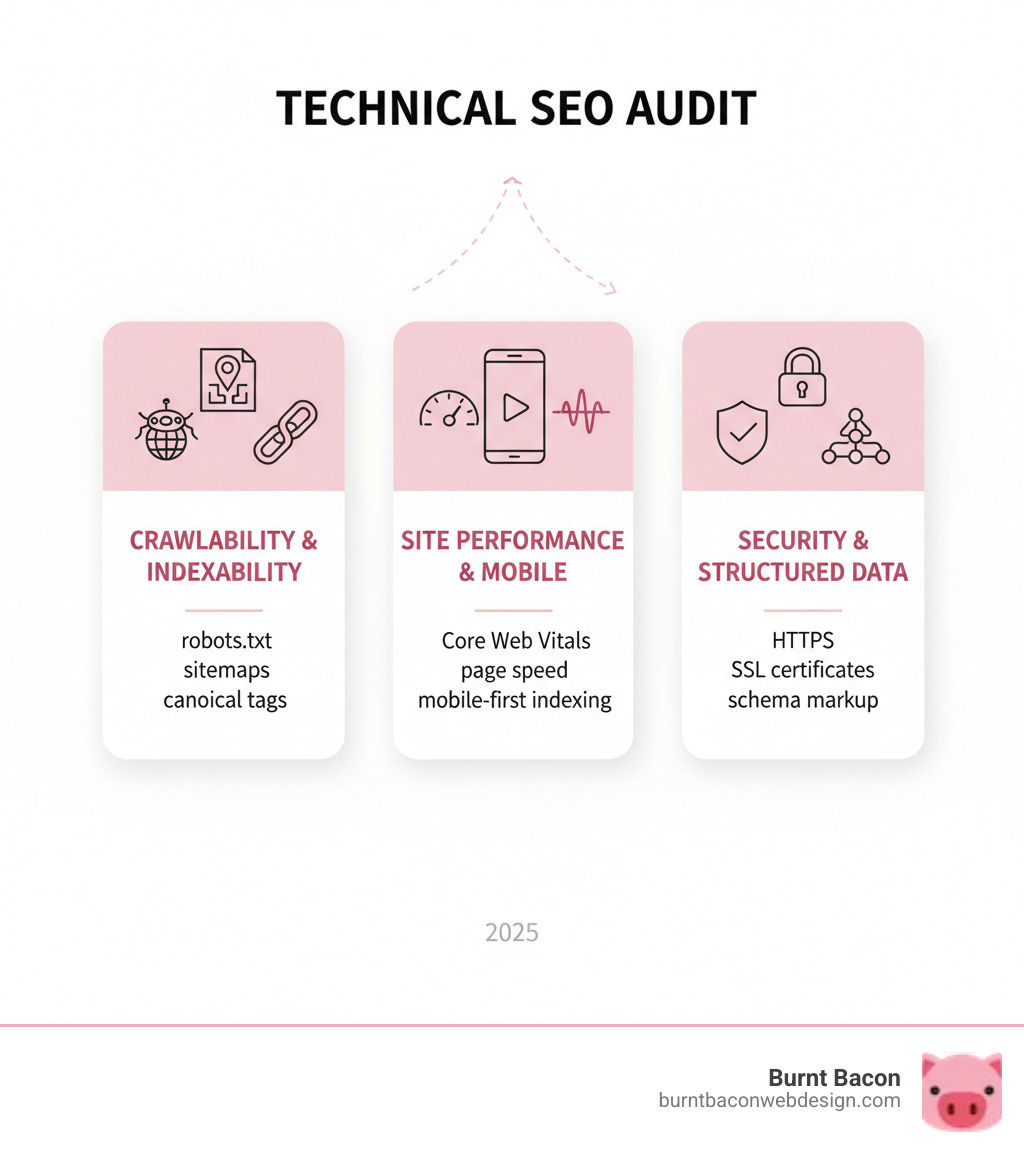
A Technical SEO audit is a deep analysis of your website’s foundation to find issues that stop search engines from crawling, indexing, and ranking your pages. It covers:
- Crawlability: Can search engines access all important pages?
- Site Speed: Are load times and Core Web Vitals optimized?
- Mobile-Friendliness: Does your site work well on mobile devices?
- Security: Is HTTPS implemented correctly?
- Site Architecture: Is your site structure logical?
- Indexability: Are the right pages appearing in search results?
If your traffic has stalled or rankings are slipping, hidden technical issues are a likely cause. The average site has over 4,500 crawl-detected SEO issues impacting its visibility. With 45.1% of all search result clicks coming from organic search, technical health is a non-negotiable part of your digital strategy.
These problems directly affect user experience. Slow load times frustrate visitors, and mobile usability issues turn away the 63% of organic search engine visits from mobile devices. When search engines can’t understand your site, they can’t show it to potential customers in Salt Lake City or South Jordan searching for what you offer.
For businesses in Salt Lake City and South Jordan, a technically sound website is the foundation for all local marketing efforts. Without it, even the best content will underperform.
With over 10 years of experience helping businesses across Utah, from Salt Lake City to South Jordan, optimize their websites, we’ve seen how a thorough Technical SEO audit can uncover the exact issues holding a site back. This guide walks you through our proven process to diagnose and fix technical problems that impact search visibility and user experience.
Basic Technical SEO audit glossary:
What is a Technical SEO Audit? (And Why It’s Non-Negotiable)
A Technical SEO audit is a health check for your website’s underlying infrastructure. Your site might look great, but if the technical foundation is shaky, search engines can’t properly crawl, index, or understand your pages.
We’ve worked with countless Utah businesses—from Salt Lake City to South Jordan—who invested in beautiful websites but were outranked by competitors. Often, the problem wasn’t their content but hidden technical issues: broken redirects, slow loading speeds, or incorrect indexing instructions hiding their best pages from Google.
These technical problems don’t just hurt your rankings; they damage user trust. When a visitor in Salt Lake City or South Jordan encounters errors or a slow mobile experience, they’re likely gone for good—and headed to your competitor.
The Foundation of Your SEO Strategy
Every SEO strategy rests on three pillars: crawlability, indexability, and rendering. Get these wrong, and even the best content marketing won’t save you.
Crawlability is your website’s ability to be explored by search engine bots. Your robots.txt file tells these bots which areas are off-limits, but it can sometimes accidentally block important pages.
Indexability determines if your pages can be added to Google’s massive database. If a page isn’t in the index, it won’t appear in search results. A Technical SEO audit ensures your important pages are indexed for local searches in Utah while keeping low-value pages out.
Rendering is how search engines execute your page’s code to see it as a visitor would. If search engines struggle to render JavaScript, they might miss crucial content.
These three elements are critical, especially since mobile devices account for 63% of organic search engine visits. Google primarily uses the mobile version of sites for indexing, so mobile glitches can torpedo your entire SEO strategy.
Technical vs. On-Page vs. Off-Page Audits
SEO audits generally fall into three categories, each focusing on a different aspect of your online presence.
| Audit Type | Focus Areas | Description |
|---|---|---|
| Technical SEO Audit | Crawlability, Indexability, Site Speed, Mobile-Friendliness, Security, Site Structure | Examines the website’s infrastructure to ensure search engines can effectively access, understand, and rank pages. |
| On-Page SEO Audit | Content Quality, Keyword Optimization, Meta Tags, Internal Linking, User Experience | Evaluates individual web pages for content relevance, keyword usage, meta information, and overall user engagement. |
| Off-Page SEO Audit | Backlink Profile, Social Signals, Brand Mentions | Analyzes external factors that influence a website’s authority and credibility, such as links from other sites and social media presence. |
A Technical SEO audit is the foundation. If search engines can’t crawl and index your site, your content and backlink efforts won’t deliver results.
The Tangible Benefits of a Healthy Website
Fixing technical issues delivers results that directly impact your business:
- Improved rankings: Removing technical barriers makes it easier for Google to understand and rank your pages.
- Increased organic traffic: Better rankings lead to more visibility and more clicks. 45.1% of all search result clicks come from organic searches.
- Better user experience: Technical fixes address frustrating issues like slow pages and broken designs, making your site more enjoyable to use.
- Lower bounce rates: A fast, error-free site encourages visitors to explore your content instead of leaving immediately.
- Higher conversion rates: A smooth experience guides visitors toward taking action. Optimized sites can see a 32% higher conversion rate compared to sites with technical problems.
A technically healthy website removes obstacles between your Utah business and your customers in Salt Lake City, South Jordan, and beyond.
The Core Components of a Comprehensive Technical SEO Audit

A Technical SEO audit is like a home inspection for your website, checking what’s working, what’s broken, and what could cause future problems. This section covers the essential areas we examine to ensure your Utah-based website is sound for both search engines and local customers.
1. Crawlability and Indexability
This step ensures search engines can find and understand your content.
- Robots.txt file: This file tells search engines which parts of your site to crawl. A misconfiguration can block your entire site. We review it to ensure it follows Google’s robots.txt guidelines.
- XML sitemap: This acts as a roadmap of your site. We check for formatting errors and ensure it’s submitted to Google Search Console, following Google’s troubleshooting guide for sitemaps.
- Crawl budget: For large sites, optimizing your crawl budget ensures your most important pages are crawled regularly.
- Orphaned pages: These are pages with no internal links. We find these orphaned pages and link to them properly.
- Redirects: A 301 redirect is permanent, while a 302 redirect is temporary. Using the wrong type can hurt your SEO. Understanding temporary redirects is key.
- Redirect chains: Multiple redirects in a row slow down your site and dilute SEO value. We find and eliminate these redirect chains and loops.
- Canonical tags: These tags specify the “official” version of a page to avoid duplicate content issues. Proper canonicalization is essential, and Google recommends specific best practices.
2. Site Architecture and Structure
A well-organized site is easier for users and search engines to steer.
- Logical hierarchy: Content should be grouped intuitively, helping search engines understand page relationships.
- Click depth: Important pages should be reachable within three clicks from the homepage. We help businesses in Salt Lake City and South Jordan bring valuable content closer to the surface, making it easy for local customers to find.
- URL structure: URLs should be clean, descriptive, and use hyphens. A good URL like
yoursite.com/services/web-designis better thanyoursite.com/page?id=12345. Google has good documentation on this, as long URLs can be problematic. - Breadcrumbs: These navigation trails show users their location on your site, improving user experience and helping crawlers understand your site structure, following UX best practices for navigation.
- Internal linking strategy: This connects related content and distributes authority. It’s a powerful but often underused SEO tactic.
3. Site Performance and Mobile Experience
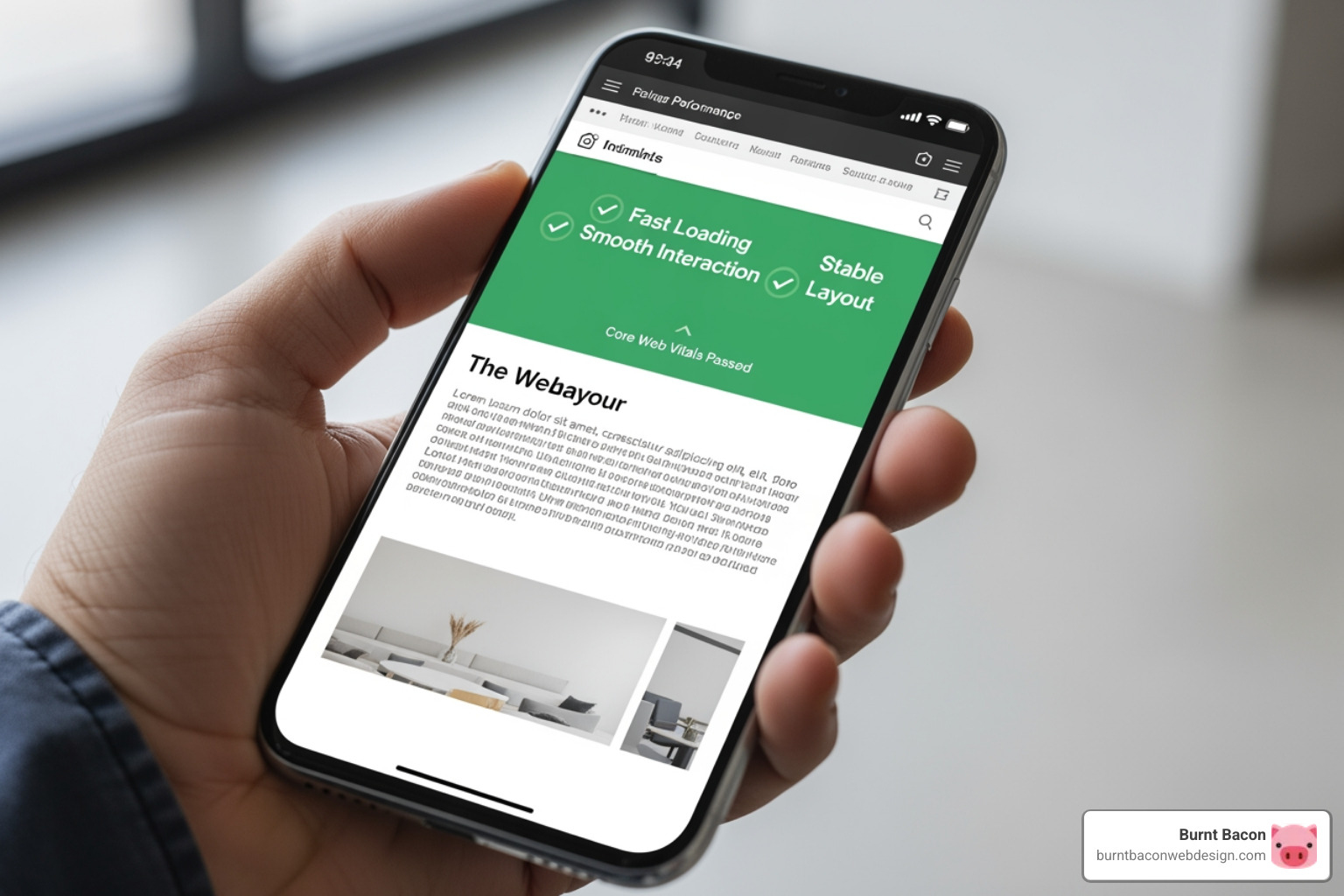
Site speed is critical, especially for attracting local customers in competitive markets like Salt Lake City. Page speed has been a Google ranking factor for years because slow sites frustrate users and increase bounce rates.
Core Web Vitals are Google’s metrics for user experience: Largest Contentful Paint (LCP) for loading, Interaction to Next Paint (INP) for interactivity, and Cumulative Layout Shift (CLS) for visual stability. Passing these Core Web Vitals directly impacts rankings.
With 60.08% of web traffic on mobile, Google uses mobile-first indexing. If your mobile site has problems, your rankings in local Utah search results will suffer.
Responsive design ensures your site adapts to any screen size. It’s the standard approach for a consistent user experience. Understanding responsive design is essential.
We use Google’s Mobile-Friendly Test and Google PageSpeed Insights to analyze performance and get specific recommendations.
4. Security and Structured Data
Security builds trust with your Utah customers, while structured data helps search engines understand your content.
- HTTPS: This encrypts the connection between your site and visitors. Google confirmed HTTPS as a ranking signal, making it essential for SEO and user trust.
- SSL certificates: We verify your certificate is valid and properly installed to avoid security warnings that scare away visitors.
- Mixed content issues: This occurs when a secure HTTPS page loads insecure HTTP resources, creating vulnerabilities. We find and fix these mixed content problems.
- Schema markup: Also called structured data, this code from Schema.org helps search engines understand your content more precisely.
- Rich results: Proper schema can make your content eligible for rich results like star ratings or FAQs, which stand out and can increase click-through rates by 20-30%.
An estimated 80% of websites haven’t implemented schema markup, giving your Utah business a significant competitive advantage in local search. We use Google’s Rich Results Test to validate your structured data.
Your Step-by-Step Guide to Performing an Audit
This section provides a practical workflow for identifying and resolving technical issues, the same process we use at Burnt Bacon for businesses in Salt Lake City and South Jordan.
Your Technical SEO Audit Toolkit
Before starting, gather the right tools. Many excellent options are free, with paid tools offering advanced features.
- Free Tools: Google Search Console is essential for insights on crawl errors, index coverage, and mobile usability. Google PageSpeed Insights analyzes speed and Core Web Vitals. Google’s Mobile-Friendly Test and Rich Results Test check for mobile issues and structured data. Lighthouse, built into Chrome, also provides performance and SEO audits.
- Paid Tools: Website crawlers like Screaming Frog SEO Spider or Sitebulb simulate how search engines explore your site, uncovering broken links, duplicate content, and more. Many offer free trials.
A 5-Step Process for Your First Audit
This straightforward process is designed to get actionable results quickly.
Step 1: Run a site crawl. Use a website crawler to find issues like broken pages (4xx errors), server errors (5xx errors), redirect chains, and duplicate content. The average site has over 4,500 issues, so the goal is to identify them for prioritization.
Step 2: Check indexing status in GSC. In Google Search Console, review the Coverage report to see which pages are indexed, have errors, or are excluded. You can also use the site:yourdomain.com search operator in Google to see what’s in the index, which is especially useful for checking if your location-specific pages for Salt Lake City or South Jordan are appearing.
Step 3: Analyze site speed and mobile-friendliness. Test key pages with Google PageSpeed Insights, focusing on Core Web Vitals (LCP, INP, CLS). Roughly 88% of mobile sites fail Google’s speed benchmarks. Since 63% of organic search visits are mobile, this step is critical for reaching customers on the go in Utah.
Step 4: Review HTTPS and security. Ensure your entire site uses HTTPS. Check for mixed content warnings, where secure pages load insecure resources. These warnings damage trust and can impact rankings, as HTTPS is a confirmed Google ranking signal. Also, verify your SSL certificate is valid.
Step 5: Validate structured data. Use Google’s Rich Results Test to confirm your schema markup is eligible for rich results. With 80% of websites lacking schema, this is a major opportunity to stand out in local Utah search results. Also, check for basic issues like images missing alt text.
Prioritizing Fixes: From Critical Errors to Minor Tweaks

An audit will produce a long list of issues. Use an “Impact vs. Effort” framework to prioritize.
- High Impact, Low Effort: These are quick wins that deliver meaningful results. Examples include fixing robots.txt errors or compressing images. Do these first.
- High Impact, High Effort: These are major projects with the biggest SEO boost, like fixing Core Web Vitals or overhauling site architecture. The investment is worth it, as these fixes can reduce bounce rates by up to 50%.
- Low Impact, Low Effort: Address these minor tweaks, like adding a few alt tags, when time allows.
- Low Impact, High Effort: Generally, deprioritize these tasks.
Start by fixing anything that blocks search engines (4xx/5xx errors, incorrect disallows). Next, tackle issues that harm user experience for your Utah customers, like slow Core Web Vitals. A Technical SEO audit is an ongoing process, but this systematic approach makes it manageable.
Frequently Asked Questions about Technical SEO Audits
Here are quick answers to common questions we hear from Utah businesses about the technical SEO audit process.
How often should I perform a technical SEO audit?
We recommend a comprehensive Technical SEO audit every 3-6 months as preventive maintenance. An immediate audit is also crucial in specific situations:
- After a website redesign or migration.
- If you notice an unexpected traffic drop.
- In response to a major Google algorithm update.
Regular check-ups help you catch issues before they impact your visibility in Salt Lake City and South Jordan search results.
Can I do a technical SEO audit myself?
Yes, you can perform many basic checks yourself. Free tools like Google Search Console and Google PageSpeed Insights are user-friendly and can identify common issues like broken links and slow speeds. This DIY approach can work for small, straightforward websites.
However, large or complex e-commerce sites often require specialized knowledge to address intricate redirect chains, rendering problems, or crawl budget optimization. Hire an expert if your site is complex, you’re unsure how to implement fixes, or you lack the time. For businesses in Salt Lake City and South Jordan, an experienced local team can provide the necessary edge to stay competitive in the Utah market.
What’s the difference between a crawl and an audit?
This is a common point of confusion. The two are related but distinct.
-
Crawling is the automated data collection process. A bot, like Screaming Frog, systematically visits your site’s pages to gather data on URLs, status codes, meta tags, and more. It’s the mechanical first step.
-
Auditing is the human analysis of that data. An expert interprets the crawl data to identify critical issues, determine root causes, prioritize fixes, and create a strategic action plan tailored to your Utah business goals. A crawl finds the what; an audit explains the why and how to fix it.
Think of it this way: a crawl is like getting medical test results, while an audit is the doctor’s diagnosis and treatment plan. A crawl is just the first step of a comprehensive Technical SEO audit.
From Audit to Action: Partner with Utah’s SEO Experts
We’ve covered what a Technical SEO audit is, its core components, and how to perform one. The key takeaway is that technical health is an ongoing, continuous process. Your website needs proactive maintenance to stay competitive, user-friendly, and visible to search engines.
For businesses in Salt Lake City, South Jordan, and across Utah, partnering with a local expert makes a significant difference. We understand the local market, search behaviors, and challenges Utah businesses face. This expertise translates into strategies that work for your specific situation.
At Burnt Bacon, we’ve spent over 10 years helping Utah businesses thrive online. As a full-service agency, we handle everything from building robust WordPress and Shopify sites to providing the ongoing SEO your site needs. We don’t just give you a list of problems; we provide actionable solutions and help you implement them.
Our comprehensive approach connects technical fixes to your broader business goals, whether it’s increasing local traffic, generating leads, or boosting sales. Plus, a portion of every project goes to Make-A-Wish, so you’re doing good while growing your business.
Ready to uncover your website’s hidden potential? Get your free video audit and see how we can help. We’ll show you exactly what’s holding your site back and provide a clear path forward to transform your website into a powerful engine for growth.