

If you run a small business and you’ve been told you need “content marketing SEO,” you’ve probably also been told it’s complicated. It isn’t. Here’s the whole idea in one sentence: write things your customers actually want to read, and set them up so Google can find them. That’s it.
The problem is that most agencies (and most AI-written blog posts) bury that simple idea under buzzwords. So let me skip the fluff and walk you through how I actually do this for clients.
A quick note on me before we go further: I’m Craig. I started Burnt Bacon as a one-person shop about ten years ago after leaving the web hosting world, and it’s grown into a small team based here in South Jordan. Most of my clients are local — hotels, veterinary clinics, e-commerce shops, and a handful of service businesses — and almost everything I’m going to say comes from work I’ve done with them.
What I actually mean by “content marketing SEO”
Two things, working together:
- SEO is the part that makes your stuff findable — site speed, page titles, the way Google reads your code, who links to you.
- Content marketing is the part that gives people a reason to land on your site in the first place — the blog posts, guides, videos, and pages that answer real questions.
Neither one does much on its own. A perfectly optimized site with nothing to read is just a fast empty room. A great blog with no SEO is a journal nobody finds. You need both pulling in the same direction.
Here’s the test I use with clients: if a stranger searched for what you do and landed on your homepage, would they leave smarter than they arrived? If yes, you’re doing content marketing. If Google can also find that page in under half a second, you’re doing SEO. Combine the two and you’ve got the thing everyone calls a strategy.
Why it’s worth doing
I’ll give you the honest version. Most of the eye-popping statistics floating around about content marketing (“3x more leads!” “62% cheaper!”) come from old HubSpot reports that have been repeated so many times nobody checks them anymore. I don’t quote them to clients.
What I can tell you from my own books:
- A veterinary client in the Salt Lake Valley went from roughly 4 organic inquiries a month to around 30 over about nine months of focused content work. No paid ads added.
- A boutique hotel I work with stopped paying OTA commissions on close to a quarter of their bookings after we built out a content layer aimed at direct-search travelers.
- A Shopify client doubled organic sessions in their first year — not because we published a ton, but because we replaced thin product copy with pages that actually answered what shoppers were asking.
None of those are overnight wins. The pattern I see is real movement somewhere between months three and six, and the compounding kicks in around the one-year mark. If anyone tells you faster, ask them for client names.
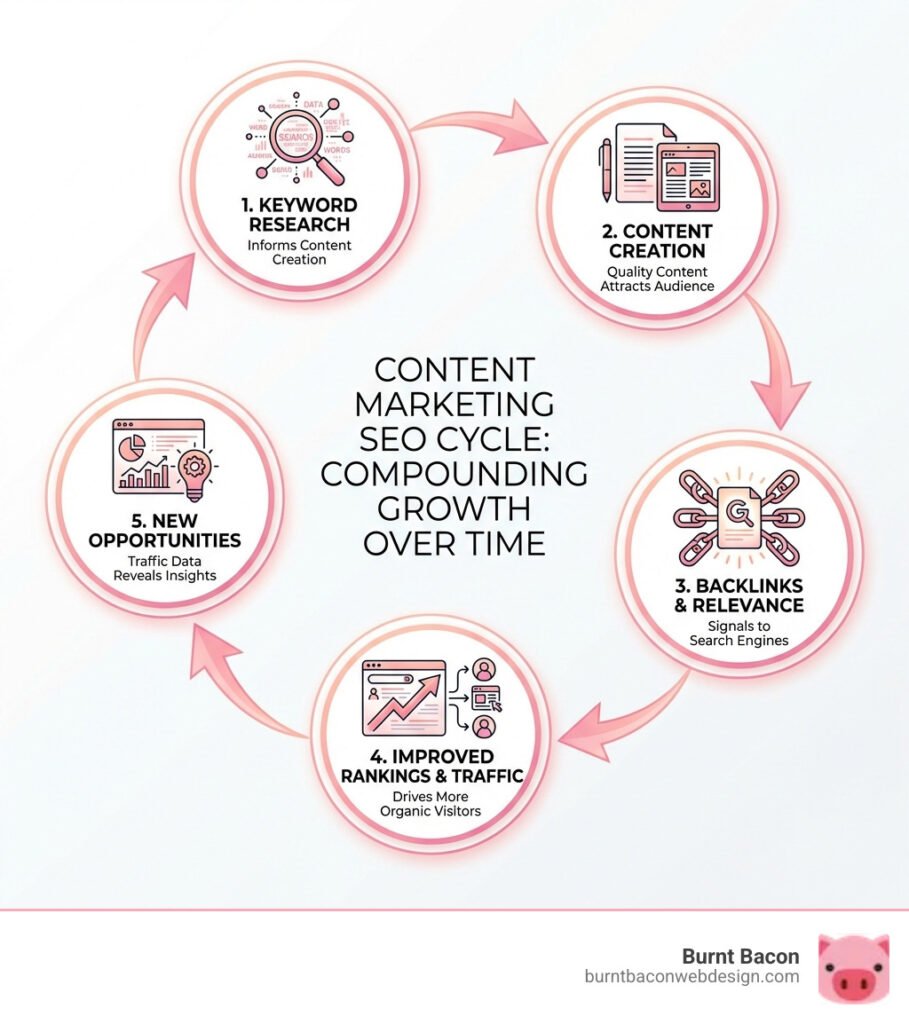
How content actually moves the SEO needle
Five mechanisms, in plain English:
Freshness. Google crawls active sites more often. A blog you actually publish to tells the algorithm you’re still in business.
More doorways. Every page is a chance to rank for something new. A site with 12 pages can rank for maybe 12 things. A site with 60 well-written pages can rank for hundreds of long-tail searches.
Links. Good content gets linked to. Generic content doesn’t. I’ve watched one solid “how to choose a vet” guide pull in more backlinks in six months than three years of service pages combined.
Time on page. If people actually read what you wrote, Google notices. If they bounce in three seconds, Google notices that too.
Trust signals (E-E-A-T). Experience, expertise, authority, trust. Writing about things you’ve actually done — with specifics — is the single best way to show Google you know your subject.
That last one is where AI-written blogs fall on their face, by the way. Google can’t always detect AI text, but it can absolutely detect content with no real point of view.
Building a strategy that doesn’t waste your time
Most failed content marketing plans I’ve inherited from other agencies have the same root cause: nobody asked the customer anything. They sat in a conference room, brainstormed “topics,” and started writing.
Here’s what I do instead. Before I write a single word for a new client, I do three things:
- Sit down with whoever answers the phone or the front-desk email. That person knows every question customers actually ask. Half my blog topics come straight from that conversation.
- Check Google’s “People also ask” box for the obvious search terms. It’s a free focus group.
- Look at what competitors are ranking for that the client isn’t. That’s the gap.
From there, the keyword research is honestly the easy part. I’m not chasing massive search volume — I’m looking for specific phrases a real customer would type when they’re close to buying. “Emergency vet open Sunday Sandy Utah” beats “veterinarian” every time, even though the second one gets a hundred times the searches.
What kinds of content actually pay off
In my experience, in rough order of ROI for a small local business:
- Service pages written for one specific service in one specific area. Boring, but they’re the workhorses.
- Long-form guides that answer the buying-decision questions. “How to pick X,” “What to expect when you Y,” “X vs. Y.”
- Case studies with real numbers. Even one good one builds more trust than ten testimonials.
- Local pages that aren’t garbage. The trick is they have to actually be different from each other — not the same 800 words with the city name swapped out. Google sees through that immediately.
- Video, if you’ll actually do it. Most clients say they will and then don’t. If you’re one of the rare ones who’ll commit, video keeps people on the page longer than anything else.
I rarely recommend infographics anymore. They were great in 2014. Now they mostly sit on Pinterest.
The on-page work
Once a page is written, the actual optimization takes maybe 20 minutes. Don’t overthink it:
- Title tag that promises something specific and includes the main phrase you want to rank for. Don’t be cute.
- Meta description written like an ad. It doesn’t directly affect rankings, but it absolutely affects whether anyone clicks.
- One H1, then H2s and H3s used to actually structure the thing, not to stuff keywords.
- Internal links to two or three related pages on your own site. This is the single most underused SEO tactic I see.
- Alt text on images that describes the image. Not a place to stuff keywords either — just describe what’s there.
- Schema markup where it makes sense (FAQ, article, local business). Yoast or Rank Math will handle most of it on WordPress.
That’s the list. If an agency is selling you a 47-point on-page checklist, they’re padding the invoice.
Link building, briefly
I’ll be honest: I think most link-building advice you read online is either outdated or a thinly veiled pitch for a link-building service. Here’s what’s actually worked for my Utah clients:
- Getting listed in genuinely relevant local directories and chamber of commerce sites. Not 500 of them — the five or six that matter.
- Building a few real relationships with complementary local businesses and cross-linking where it makes sense. A wedding photographer and a venue. A vet and a groomer.
- Writing something so specific that other people in the industry can’t help but link to it. This is hard. When it works, one link from a real source is worth fifty from a directory.
I don’t buy links. I don’t recommend you buy links. And if someone offers you “guaranteed DA 50+ backlinks,” close the email.
How to tell if it’s working
The metrics that actually matter, in order:
- Inquiries. Phone calls, form fills, booked consults. This is the only number that pays the bills.
- Organic traffic that’s converting. Not raw traffic — traffic from the search terms that lead to money.
- Keyword rankings for the handful of terms that actually drive your business. Not the vanity ones.
- Time on page and scroll depth, as a sanity check that people are reading.
I look at Google Search Console weekly and GA4 monthly with clients. Anyone who insists on a daily dashboard is selling motion, not progress.
Mistakes I see constantly
- Publishing for the sake of publishing. One genuinely useful post a month beats four rushed ones. I’d rather have a client publish six great pieces a year than a forced weekly grind.
- Repeating the target keyword like a chant. Google’s been able to recognize natural language for years. Keyword stuffing now actively hurts you.
- Treating SEO like a one-time project. You can absolutely DIY this, but you can’t “finish” it. Search results move, competitors publish, algorithms shift.
- Ignoring the rest of the site. The world’s best blog post on a site that takes 8 seconds to load on mobile won’t rank. Fix the foundation first.
- Using AI to crank out 50 blog posts and wondering why nothing happens. Google’s helpful-content systems are getting better at detecting low-effort AI content every quarter. Use AI to help you write — don’t let it do the writing.
A few honest answers to common questions
Is SEO part of content marketing, or the other way around?
Neither, really. They’re separate disciplines that share most of their work. SEO without content has nothing to optimize. Content without SEO doesn’t get found. Stop trying to label which one owns the other.
How often should I publish?
As often as you can do it well. For most small businesses I work with, that’s one or two solid posts a month. If you’re publishing weekly and the quality is dropping, you’re going backwards.
Can I do content marketing without SEO?
Yes — if you have another way to get eyes on your content, like a big email list, an active social audience, or a paid ad budget. Most small businesses don’t have those, which is why SEO ends up being the most efficient distribution channel they have.
How long until I see results?
Real answer: three to six months for early signs, twelve months for the kind of growth you can build a business plan around. Anyone promising faster is lying or working in a niche with no competition.
If you’re going to do one thing
Pick the single question your customers ask most often. Write the best answer to it that exists anywhere on the internet — better than your competitors, better than the AI-written posts cluttering page one. Put it on your site with a clear title and a clear page URL. Link to it from your homepage.
That one page, done well, will outperform fifty mediocre ones. I’ve seen it happen too many times to think it’s a coincidence.
And if you want to talk about whether content marketing makes sense for your specific business, I’m easy to find. I don’t do hard sells and I’ll tell you straight if I don’t think it’s the right move for where you are. That’s mostly how Burnt Bacon got built.
— Craig
Burnt Bacon Web Design • South Jordan, Utah • 385.309.2876
SEO and Content Marketing: How They Actually Work Together
By Craig Flickinger, Burnt Bacon Web Design
If you run a small business and you’ve been told you need “content marketing SEO,” you’ve probably also been told it’s complicated. It isn’t. Here’s the whole idea in one sentence: write things your customers actually want to read, and set them up so Google can find them. That’s it.
The problem is that most agencies (and most AI-written blog posts) bury that simple idea under buzzwords. So let me skip the fluff and walk you through how I actually do this for clients.
A quick note on me before we go further: I’m Craig. I started Burnt Bacon as a one-person shop about ten years ago after leaving the web hosting world, and it’s grown into a small team based here in South Jordan. Most of my clients are local — hotels, veterinary clinics, e-commerce shops, and a handful of service businesses — and almost everything I’m going to say comes from work I’ve done with them.
What I actually mean by “content marketing SEO”
Two things, working together:
- SEO is the part that makes your stuff findable — site speed, page titles, the way Google reads your code, who links to you.
- Content marketing is the part that gives people a reason to land on your site in the first place — the blog posts, guides, videos, and pages that answer real questions.
Neither one does much on its own. A perfectly optimized site with nothing to read is just a fast empty room. A great blog with no SEO is a journal nobody finds. You need both pulling in the same direction.
Here’s the test I use with clients: if a stranger searched for what you do and landed on your homepage, would they leave smarter than they arrived? If yes, you’re doing content marketing. If Google can also find that page in under half a second, you’re doing SEO. Combine the two and you’ve got the thing everyone calls a strategy.
Why it’s worth doing
I’ll give you the honest version. Most of the eye-popping statistics floating around about content marketing (“3x more leads!” “62% cheaper!”) come from old HubSpot reports that have been repeated so many times nobody checks them anymore. I don’t quote them to clients.
What I can tell you from my own books:
- A veterinary client in the Salt Lake Valley went from roughly 4 organic inquiries a month to around 30 over about nine months of focused content work. No paid ads added.
- A boutique hotel I work with stopped paying OTA commissions on close to a quarter of their bookings after we built out a content layer aimed at direct-search travelers.
- A Shopify client doubled organic sessions in their first year — not because we published a ton, but because we replaced thin product copy with pages that actually answered what shoppers were asking.
None of those are overnight wins. The pattern I see is real movement somewhere between months three and six, and the compounding kicks in around the one-year mark. If anyone tells you faster, ask them for client names.
How content actually moves the SEO needle
Five mechanisms, in plain English:
Freshness. Google crawls active sites more often. A blog you actually publish to tells the algorithm you’re still in business.
More doorways. Every page is a chance to rank for something new. A site with 12 pages can rank for maybe 12 things. A site with 60 well-written pages can rank for hundreds of long-tail searches.
Links. Good content gets linked to. Generic content doesn’t. I’ve watched one solid “how to choose a vet” guide pull in more backlinks in six months than three years of service pages combined.
Time on page. If people actually read what you wrote, Google notices. If they bounce in three seconds, Google notices that too.
Trust signals (E-E-A-T). Experience, expertise, authority, trust. Writing about things you’ve actually done — with specifics — is the single best way to show Google you know your subject.
That last one is where AI-written blogs fall on their face, by the way. Google can’t always detect AI text, but it can absolutely detect content with no real point of view.
Building a strategy that doesn’t waste your time
Most failed content marketing plans I’ve inherited from other agencies have the same root cause: nobody asked the customer anything. They sat in a conference room, brainstormed “topics,” and started writing.
Here’s what I do instead. Before I write a single word for a new client, I do three things:
- Sit down with whoever answers the phone or the front-desk email. That person knows every question customers actually ask. Half my blog topics come straight from that conversation.
- Check Google’s “People also ask” box for the obvious search terms. It’s a free focus group.
- Look at what competitors are ranking for that the client isn’t. That’s the gap.
From there, the keyword research is honestly the easy part. I’m not chasing massive search volume — I’m looking for specific phrases a real customer would type when they’re close to buying. “Emergency vet open Sunday Sandy Utah” beats “veterinarian” every time, even though the second one gets a hundred times the searches.
What kinds of content actually pay off
In my experience, in rough order of ROI for a small local business:
- Service pages written for one specific service in one specific area. Boring, but they’re the workhorses.
- Long-form guides that answer the buying-decision questions. “How to pick X,” “What to expect when you Y,” “X vs. Y.”
- Case studies with real numbers. Even one good one builds more trust than ten testimonials.
- Local pages that aren’t garbage. The trick is they have to actually be different from each other — not the same 800 words with the city name swapped out. Google sees through that immediately.
- Video, if you’ll actually do it. Most clients say they will and then don’t. If you’re one of the rare ones who’ll commit, video keeps people on the page longer than anything else.
I rarely recommend infographics anymore. They were great in 2014. Now they mostly sit on Pinterest.
The on-page work
Once a page is written, the actual optimization takes maybe 20 minutes. Don’t overthink it:
- Title tag that promises something specific and includes the main phrase you want to rank for. Don’t be cute.
- Meta description written like an ad. It doesn’t directly affect rankings, but it absolutely affects whether anyone clicks.
- One H1, then H2s and H3s used to actually structure the thing, not to stuff keywords.
- Internal links to two or three related pages on your own site. This is the single most underused SEO tactic I see.
- Alt text on images that describes the image. Not a place to stuff keywords either — just describe what’s there.
- Schema markup where it makes sense (FAQ, article, local business). Yoast or Rank Math will handle most of it on WordPress.
That’s the list. If an agency is selling you a 47-point on-page checklist, they’re padding the invoice.
Link building, briefly
I’ll be honest: I think most link-building advice you read online is either outdated or a thinly veiled pitch for a link-building service. Here’s what’s actually worked for my Utah clients:
- Getting listed in genuinely relevant local directories and chamber of commerce sites. Not 500 of them — the five or six that matter.
- Building a few real relationships with complementary local businesses and cross-linking where it makes sense. A wedding photographer and a venue. A vet and a groomer.
- Writing something so specific that other people in the industry can’t help but link to it. This is hard. When it works, one link from a real source is worth fifty from a directory.
I don’t buy links. I don’t recommend you buy links. And if someone offers you “guaranteed DA 50+ backlinks,” close the email.
How to tell if it’s working
The metrics that actually matter, in order:
- Inquiries. Phone calls, form fills, booked consults. This is the only number that pays the bills.
- Organic traffic that’s converting. Not raw traffic — traffic from the search terms that lead to money.
- Keyword rankings for the handful of terms that actually drive your business. Not the vanity ones.
- Time on page and scroll depth, as a sanity check that people are reading.
I look at Google Search Console weekly and GA4 monthly with clients. Anyone who insists on a daily dashboard is selling motion, not progress.
Mistakes I see constantly
- Publishing for the sake of publishing. One genuinely useful post a month beats four rushed ones. I’d rather have a client publish six great pieces a year than a forced weekly grind.
- Repeating the target keyword like a chant. Google’s been able to recognize natural language for years. Keyword stuffing now actively hurts you.
- Treating SEO like a one-time project. You can absolutely DIY this, but you can’t “finish” it. Search results move, competitors publish, algorithms shift.
- Ignoring the rest of the site. The world’s best blog post on a site that takes 8 seconds to load on mobile won’t rank. Fix the foundation first.
- Using AI to crank out 50 blog posts and wondering why nothing happens. Google’s helpful-content systems are getting better at detecting low-effort AI content every quarter. Use AI to help you write — don’t let it do the writing.
A few honest answers to common questions
Is SEO part of content marketing, or the other way around?
Neither, really. They’re separate disciplines that share most of their work. SEO without content has nothing to optimize. Content without SEO doesn’t get found. Stop trying to label which one owns the other.
How often should I publish?
As often as you can do it well. For most small businesses I work with, that’s one or two solid posts a month. If you’re publishing weekly and the quality is dropping, you’re going backwards.
Can I do content marketing without SEO?
Yes — if you have another way to get eyes on your content, like a big email list, an active social audience, or a paid ad budget. Most small businesses don’t have those, which is why SEO ends up being the most efficient distribution channel they have.
How long until I see results?
Real answer: three to six months for early signs, twelve months for the kind of growth you can build a business plan around. Anyone promising faster is lying or working in a niche with no competition.
If you’re going to do one thing
Pick the single question your customers ask most often. Write the best answer to it that exists anywhere on the internet — better than your competitors, better than the AI-written posts cluttering page one. Put it on your site with a clear title and a clear page URL. Link to it from your homepage.
That one page, done well, will outperform fifty mediocre ones. I’ve seen it happen too many times to think it’s a coincidence.
And if you want to talk about whether content marketing makes sense for your specific business, I’m easy to find. I don’t do hard sells and I’ll tell you straight if I don’t think it’s the right move for where you are. That’s mostly how Burnt Bacon got built.