

Why Competitive SEO Analysis is Your Secret Weapon
A competitive SEO analysis is the process of researching rival websites’ search engine optimization strategies to uncover opportunities and improve your own rankings. It’s about working smarter, not just harder. Here’s what you need to know:
Key Steps in Competitive SEO Analysis:
- Identify your SEO competitors – This goes beyond your direct business rivals to include any domain ranking for your target keywords.
- Analyze keyword gaps – Find valuable keywords they rank for that you’ve completely missed, giving you a pipeline of new content ideas.
- Study their content strategy – Look at the topics, formats (blogs, videos, guides), and quality of their top-performing pages to understand what resonates with your shared audience.
- Examine their backlink profile – Find high-authority websites linking to them and identify opportunities for your own outreach and link-building campaigns.
- Audit their technical SEO – Check for weaknesses like slow site speed, poor mobile-friendliness, or a confusing site structure that you can outperform.
- Monitor and adapt – SEO is dynamic; continuously track competitor movements and algorithm changes to adjust your strategy and stay ahead.
As an SEO expert with over a decade of experience, I always say: “Your competitors are a goldmine of information you can use to improve your search engine optimization (SEO) strategy.” This couldn’t be more true for Utah businesses trying to stand out in competitive local markets.
The bottom line: Instead of guessing what works, you can reverse-engineer your competitors’ success and build upon it. This saves time, reduces risk, and gives you a clear roadmap to better rankings.
Most businesses skip this crucial step and wonder why their SEO efforts fall flat. Meanwhile, smart competitors are already using this data to outrank them. The good news? Once you know how to do it, competitive analysis becomes your unfair advantage.
I’m Craig Flickinger, and over my 10+ years helping Utah businesses with web design and SEO, I’ve seen how competitive SEO analysis transforms struggling websites into ranking powerhouses. Whether you’re a local plumber in Salt Lake City or a statewide service provider, understanding what your competitors are doing right (and wrong) is the fastest path to SEO success.
What is SEO Competitor Analysis and Why is It Your Secret Weapon?
Competitive SEO analysis is the practice of studying the pages that already win in Google so you can make smarter, faster decisions. Instead of guessing which keywords or content formats might work, you build a strategy on data your rivals have already generated.
Why it matters:
- Skip costly trial-and-error by learning from proven winners.
- Benchmark your own visibility against market leaders and understand the true level of effort required to rank.
- Spot keyword, content, or link gaps that no one in your market is serving yet, creating a blue ocean of opportunity.
- Reduce risk by avoiding tactics Google clearly isn’t rewarding in your niche.
For Utah businesses, these insights guide everything from keyword research to conversion-rate optimization. Our guide on Higher Conversions: Best Practices for CRO Success shows how the same intel can boost sales funnels.
Who are your real competitors?
In search, a competitor is any site that outranks you for the phrases you want, whether or not they sell the same product. It’s crucial to analyze all types:
- Direct – These are the obvious ones. If you’re a roofer in Salt Lake City, other local roofing companies are your direct competitors.
- Indirect – These businesses offer a different solution to the same customer need. For that roofer, a large home-improvement store that sells roofing materials is an indirect competitor for DIY-related searches.
- Content – These are publishers that capture informational traffic. A popular home-improvement blog with an article on “how to spot roof damage” competes for that specific search term, even if they don’t offer roofing services.
- SERP – This is the broadest category and includes every single domain that appears in the top results for your target keywords. This can include directories like Yelp, news sites, or even Wikipedia. They all take up valuable digital real estate.
Ethical “spying” pays off
You’re not copying—you’re finding:
- Weaknesses you can exploit (slow pages, thin content, outdated information)
- Strengths you can emulate (successful topics, high-authority backlinks, great user experience)
- Priorities to tackle first (gaps with the highest potential ROI)
See real-world examples in Website Traffic and Sales: What Affects Organic Keyword Search?.
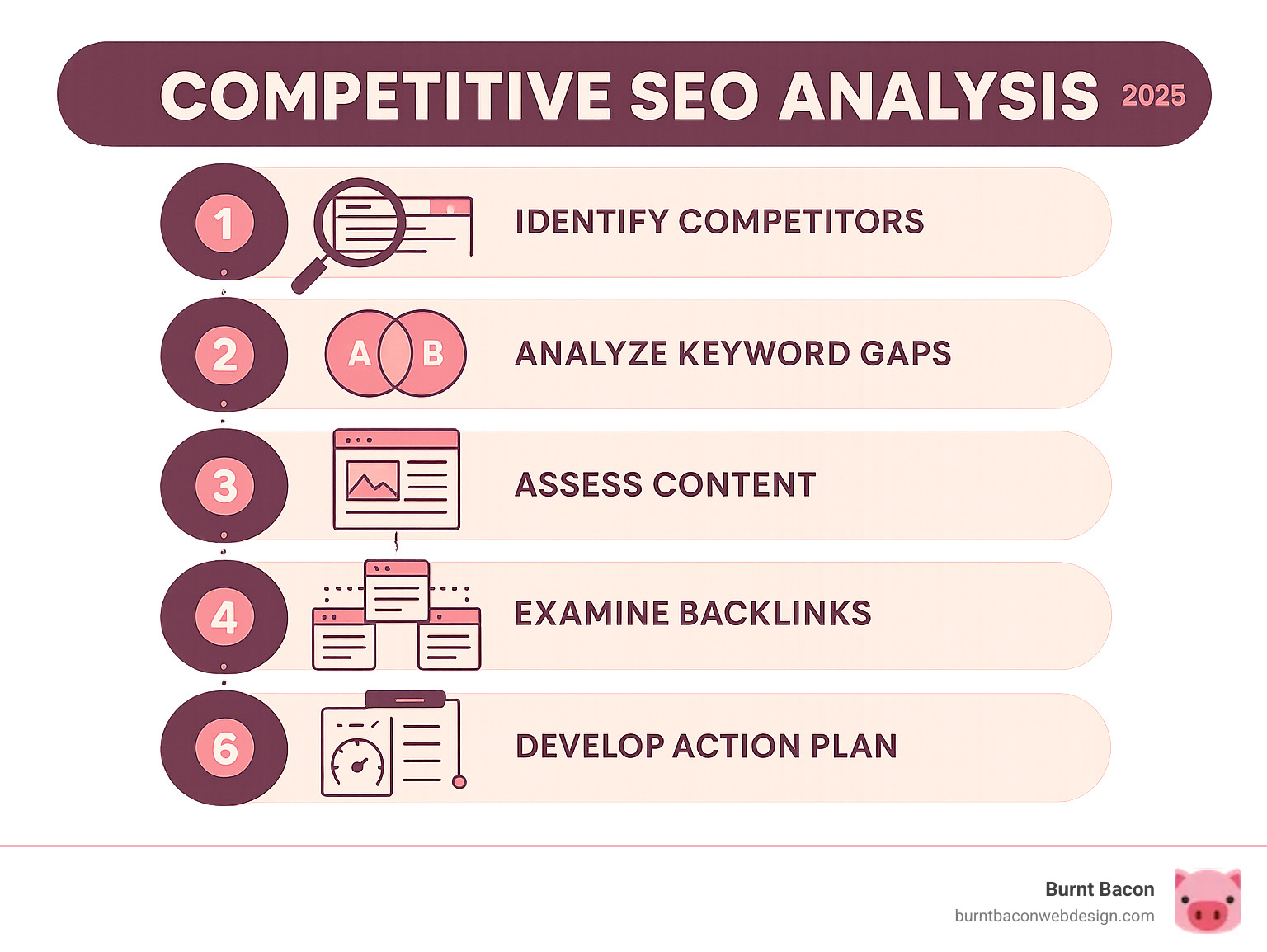
The 6-Step Guide to a Winning Competitive SEO Analysis

Follow these six steps in order. Each one builds on the last, so resist the urge to cherry-pick for the most comprehensive results.
Step 1: Identify Your SEO Competitors
- Open an incognito window and search your core business phrases (e.g., “plumbers in salt lake city,” “utah web design agency”).
- Write down every domain that appears consistently on page one for multiple terms.
- Separate national brands from local sites; both steal clicks from your target market, but your strategy to beat them will differ.
- You can do this manually, but SEO tools can automate this process, revealing competitors you didn’t even know you had.
Need local help? See The Importance of Local SEO in Salt Lake City.
Step 2: Find Keyword Gaps
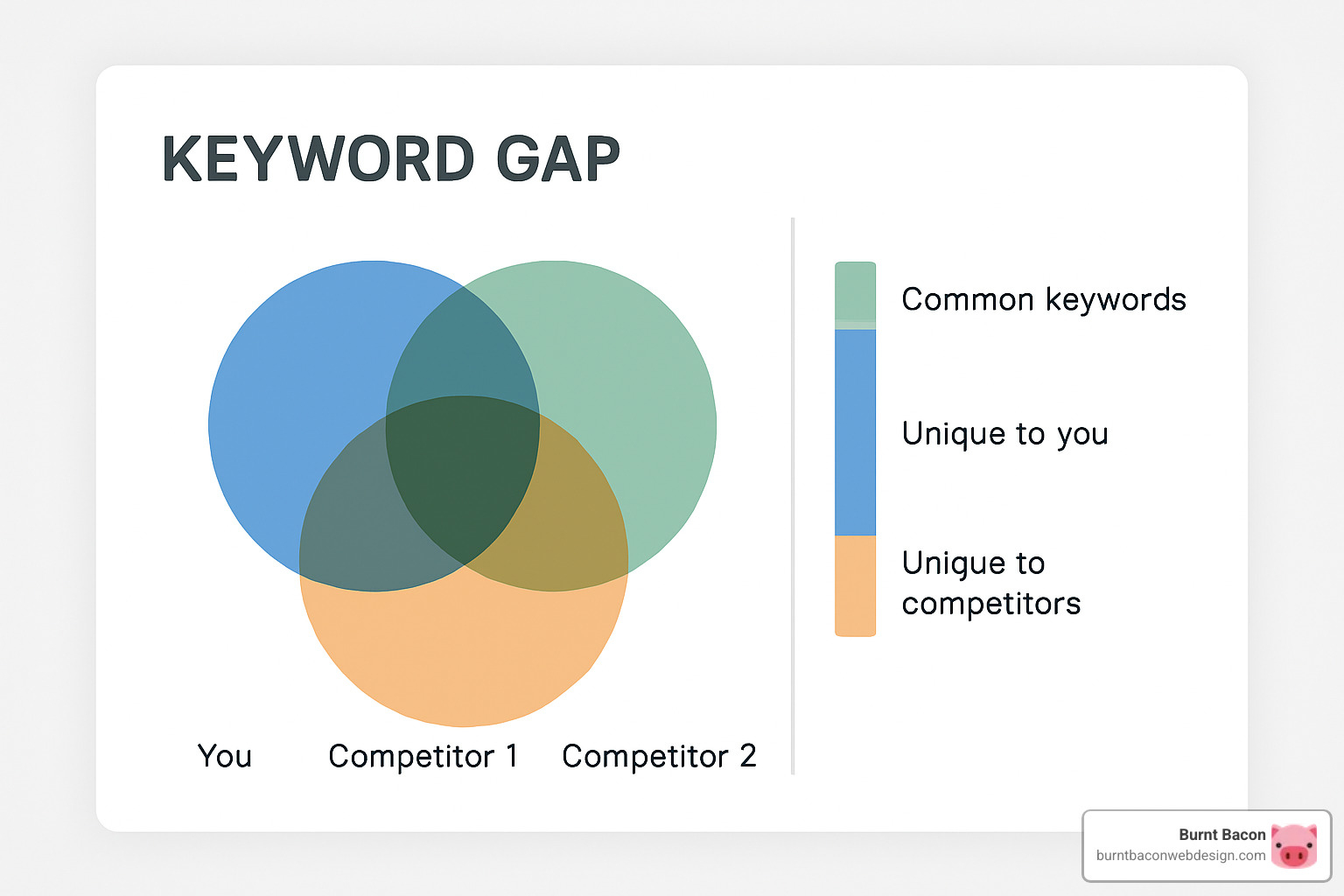
Compare your ranking keyword list to theirs using an SEO tool:
- Common keywords – These validate that you’re chasing the right core terms. Check if your content is as good as or better than theirs for these shared terms.
- Missing keywords – These are topics they rank for but you don’t. Prioritize “page-2” terms where your competitors are ranking but aren’t on the first page. These are often easier to capture and can provide quick traffic boosts.
- Paid keywords – If they consistently buy traffic for a specific phrase, it’s a strong signal that the keyword is profitable and converts well.
Step 3: Deconstruct Their Content Strategy
Review the ten most-visited pages on each competitor’s site to understand what drives their traffic:
- Format: Are they using long-form blog posts, videos, interactive tools, or simple service pages?
- Depth: Note the average word count, use of supporting media (images, infographics), and how thoroughly they cover the topic.
- E-E-A-T signals: For Experience, Expertise, Authoritativeness, and Trustworthiness, look for detailed author bios, case studies with real data, customer testimonials, and links to reputable sources. These are trust signals Google values highly.
- SERP features: See if they own featured snippets, “People Also Ask” boxes, or video carousels. This shows what content formats Google prefers for that query.
Then, outline a plan to create something significantly better, not just a copy.
Step 4: Uncover Backlink Opportunities

Export your rivals’ referring domains and filter for high-value targets:
- High-authority industry sites: Links from well-known blogs or news outlets in your niche.
- Local organizations or chambers: For Utah businesses, links from local directories, news, or the Chamber of Commerce are pure gold.
- Broken links: Find links pointing to a competitor’s 404 page and offer your relevant content as a replacement.
Don’t just look at the number of links; analyze their quality. Are they from relevant, respected sites? This context is crucial for building a superior link-building strategy. Links remain a top ranking factor.
Step 5: Audit Technical SEO
Run competitor URLs through a tool like Google’s Core Web Vitals. If their user experience lags, you have a clear opening. Beyond speed, check their site architecture (is it logical?), use of structured data (Schema markup), and mobile rendering. A technically superior site provides a better user experience, which is a key ranking factor. If you find weaknesses, you can outrank them by following How to Speed Up My Site (2024 Update) or using our Website Speed Optimization Services.
Step 6: Prioritize & Act
Sort your findings into a simple matrix: “quick wins” (low effort, high impact) and “long plays” (high effort, high impact). A quick win might be updating an old blog post with new information to target a keyword gap. A long play would be creating a comprehensive, 10x content piece on a competitive core topic. Turn these items into a project plan with owners, deadlines, and measurable KPIs.
Tools and Timing: Staying Ahead
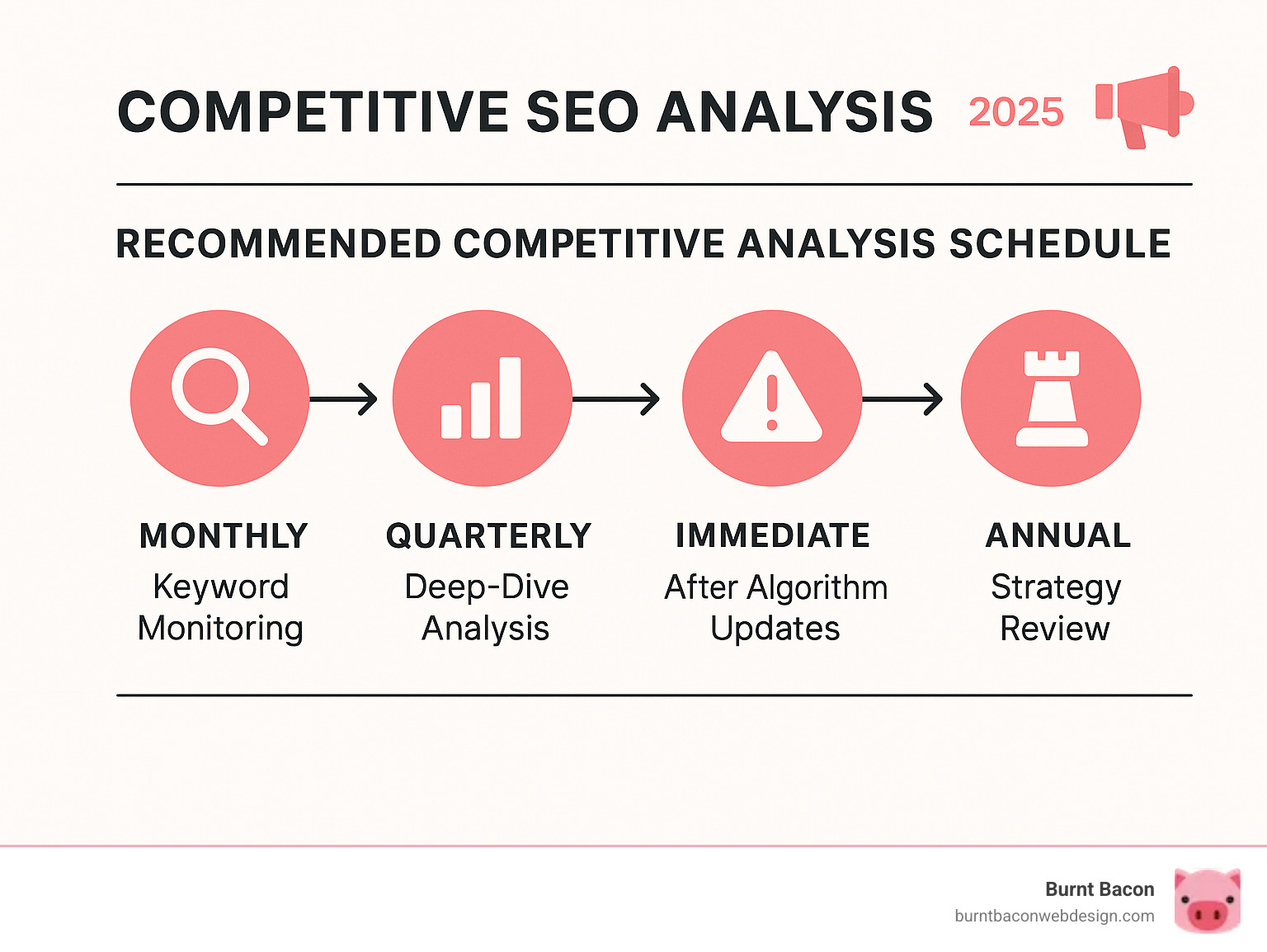
Competitive analysis isn’t one-and-done. Rankings shift, algorithms change, and new players pop up. A light but steady cadence keeps you proactive.
Must-Have Tools
- Free: incognito Google search, Search Console, Google PageSpeed Insights
- All-in-one suites: Ahrefs, Semrush, Moz
- Specialists: standalone keyword explorers, backlink checkers, site-audit crawlers
Start free; upgrade when the ROI is clear.
How Often?
- Initial deep dive – when you begin SEO or enter a new niche
- Quarterly review – refresh keyword, content, and link gaps
- Monthly pulse – track rank movement and new competitor pages
- Triggered check – after a core update or sudden ranking drop
Local brands should also watch Google Business Profile insights, as outlined in Boost Rankings by Tracking Local SEO Performance.
Frequently Asked Questions about Competitive SEO Analysis
Direct competitor vs. SEO competitor?
Direct competitors sell the same thing. SEO competitors occupy the SERP spots you want—even if they’re a blog or directory.
How many sites should I review?
Three to five core domains are enough to reveal most insights. Add more only after acting on the first batch.
Can I do it for free?
Yes. Manual Google searches plus free tool tiers deliver plenty of data. Paid platforms mainly save time.
When will I see results?
Insights are instant; ranking gains usually appear in 3–6 months, depending on keyword difficulty and implementation speed.
Should I copy exactly what they do?
No. Reverse-engineer why it works, then create something more useful, faster, or deeper.
What if they’re giant brands?
Leverage your agility. Target long-tail phrases, local intent, and niche expertise that big sites overlook.
Conclusion: Turn Insights Into Action

Great research means nothing until you ship improvements. Use a quick SWOT (Strengths, Weaknesses, Opportunities, Threats) analysis based on your findings to pick your first moves. Tackle “striking-distance” keywords where a small push can yield big results, and schedule the bigger content or link projects next. Then, commit to the process by looping back every quarter to refresh your data and stay agile.
Need a hand turning this powerful intel into tangible traffic and revenue? Burnt Bacon has spent a decade helping Utah companies outsmart the competition with data-driven SEO. Explore our Local SEO Salt Lake City and Affordable SEO Salt Lake City services to see how we can build your custom roadmap to success.
Will you be the one studying competitors—or the one being studied?