
Why SEO Content Writing Powers Your Online Growth
SEO content writing is the practice of creating web content strategically designed to rank higher in search engines, helping your Utah-based business connect with local customers. It combines keyword research, clear structure, user intent matching, and authoritative information to attract organic traffic from places like Salt Lake City and South Jordan and build trust with your audience.
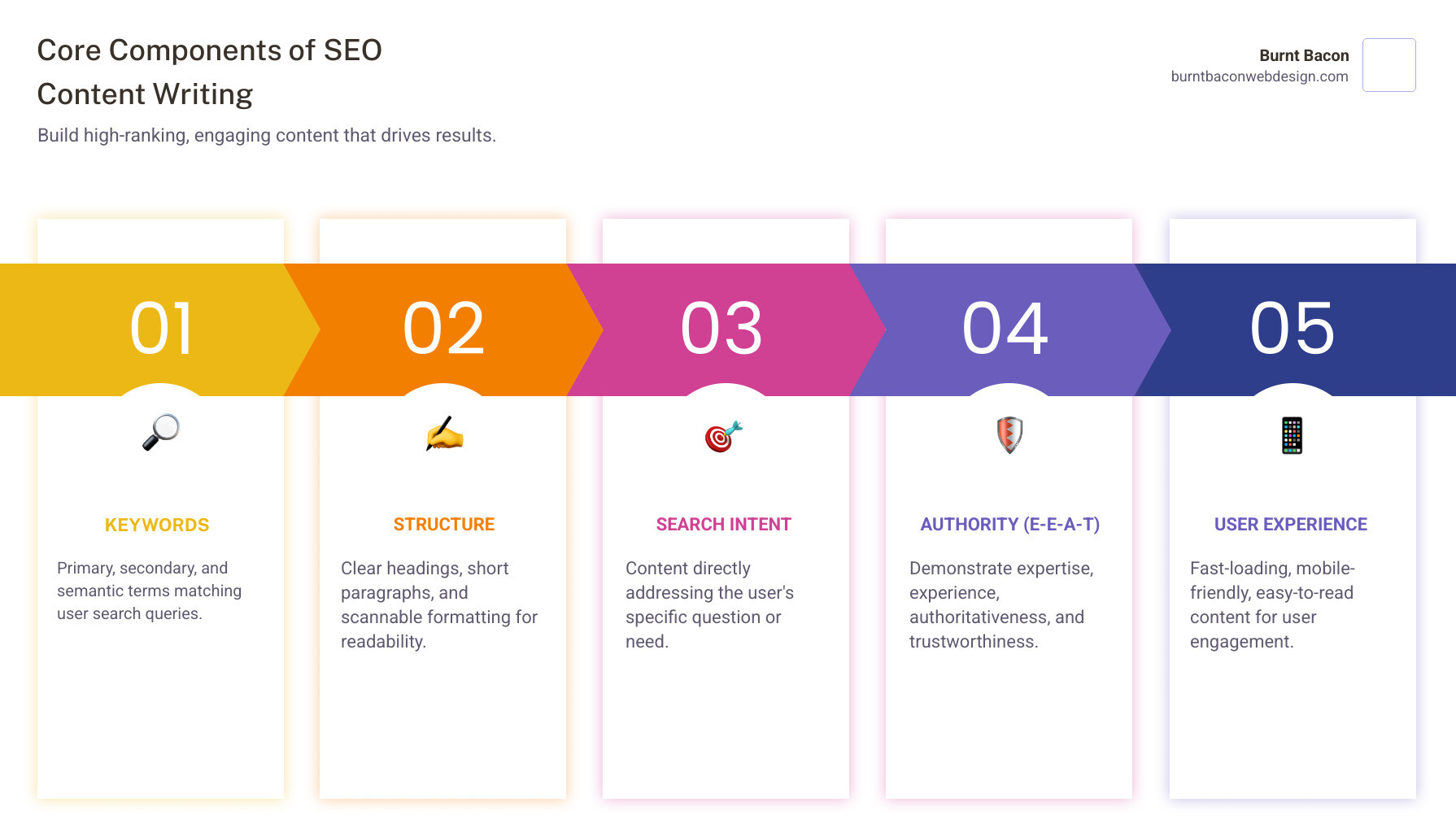
Core components of effective SEO content writing:
- Keywords: Primary, secondary, and semantic terms that match what people search for
- Structure: Clear headings, short paragraphs, and scannable formatting
- Intent: Content that answers the specific question or need behind a search
- Authority: Demonstrating expertise, experience, and trustworthiness (E-E-A-T)
- User Experience: Fast-loading, mobile-friendly, easy-to-read content
The stakes are high: more than half of all clicks go to the top three search results. If your content doesn’t rank, it effectively doesn’t exist. Many Utah business owners feel anxious about SEO writing because it seems complex or constantly changing.
It doesn’t have to be that way.
Good SEO content writing isn’t about gaming the system. It’s about understanding what your potential customers in the Salt Lake Valley are searching for and creating helpful content that answers their questions. When you do that consistently, search engines reward you with visibility, and readers reward you with their business.
I’m Craig Flickinger BB, founder of Burnt Bacon Web Design in South Jordan, Utah. With over 10 years of experience in SEO content writing and website support, I’ve seen how the right content strategy transforms online visibility. Let me show you how.
SEO content writing vocab explained:
The Foundation: Understanding Modern SEO Writing
Remember the early internet days of “keyword stuffing”? Awful stuff. Thankfully, those days are behind us. Today’s SEO content writing is where creativity meets strategy—and it’s better for everyone involved.
What sets SEO content writing apart from regular content writing? It has an explicit mission to rank in search engines while genuinely serving your audience. Regular content focuses on engagement; SEO writing adds strategic layers like keyword research, optimized meta elements, and a structure that appeals to both humans and search algorithms.
The reason for this evolution is that search engines got much smarter. Google now uses sophisticated algorithms that understand context and user intent. They don’t just match keywords; they understand what people in Salt Lake City and Provo are actually looking for. When we satisfy those real people, Google rewards us with better rankings.
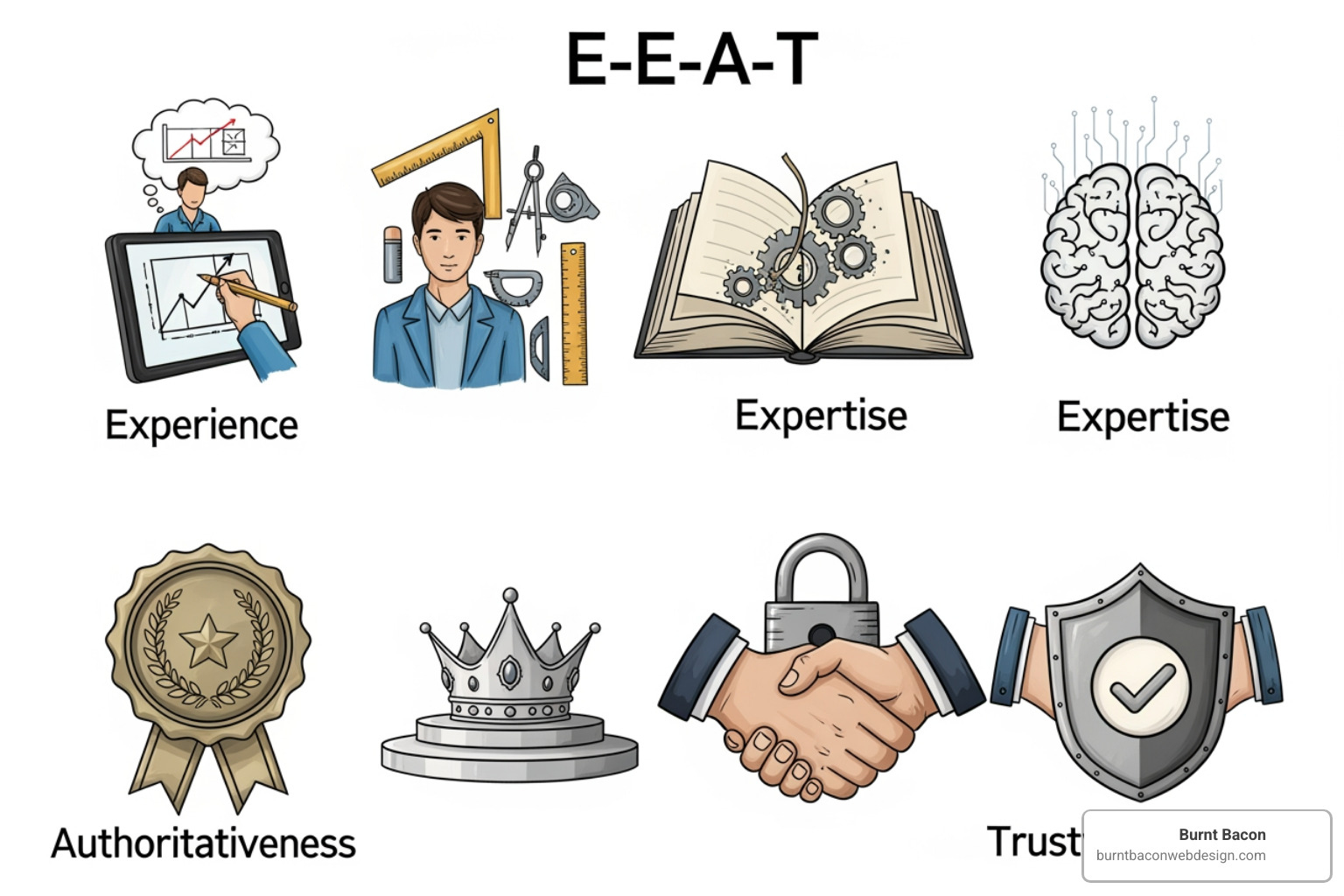
This brings us to a critical framework in modern SEO: E-E-A-T. It stands for Experience, Expertise, Authoritativeness, and Trustworthiness. Google uses these principles to evaluate if your content is credible and helpful. For example, a Utah-based HVAC company should write about furnace maintenance reflecting real-world experience with Utah’s climate, not just generic advice. That’s E-E-A-T in action.
Google takes this especially seriously for YMYL (Your Money or Your Life) topics like health and finance, where bad information could be harmful. Google’s clear guidelines on high-quality content make E-E-A-T a central pillar of their evaluation.
At its heart, modern SEO content writing is about “searcher task accomplishment.” Did your content help someone solve their problem? If someone in South Jordan finds genuine value in your content, Google recognizes that success and ranks you higher.
What is Search Intent and Why Does It Matter?
Understanding search intent reveals the “why” behind a search. If you don’t match it, users will leave, and Google will notice. Intent generally falls into four categories:
- Informational: Someone wants to learn (“best hiking trails near Salt Lake City”). They need guides and blog posts.
- Navigational: Someone is looking for a specific site (“Burnt Bacon Web Design”).
- Commercial investigation: Someone is comparing options (“best web design agencies in Utah”). They need reviews and comparisons.
- Transactional: Someone is ready to act (“hire,” “buy,” or “price”).
To nail search intent, we analyze the Search Engine Results Pages (SERPs) for your target keywords. What’s already ranking? We also check “People Also Ask” boxes to see the questions on people’s minds. This is part of our competitive SEO analysis process, ensuring we create content that helps Utah searchers accomplish their goals.
How Keywords Fit into Modern SEO Content Writing
Keywords still guide searchers to your content, but we use them differently now. It’s all about natural language and context. We focus on three layers:
- Primary keywords: Your main target, like “SEO content writing.”
- Secondary keywords: Related variations, like “how to write SEO content.”
- LSI keywords: Conceptually related terms that provide context (e.g., “organic traffic,” “content strategy”). They are crucial for semantic search, as Google understands meaning, not just words.
We weave these keywords naturally into headings, intros, and the body. We use tools to find real questions and user-generated keywords that reflect how people actually talk.
Crucially, we ignore keyword density myths. Google has stated they don’t pay attention to keyword density. If someone tells you there’s a “magic percentage,” they’re stuck in 2005. Natural integration that serves the reader is what matters.
The Blueprint for High-Ranking SEO Content Writing
Think of SEO content writing as designing a welcoming space that readers and search engines love. Readers typically only absorb 20-28% of the words on a page; they scan for answers. This is where content design comes in—creating content for Utah businesses that’s scannable and easy to steer. While long-form, comprehensive content often ranks best, the secret is making it feel easy to read through smart structure and visuals.
Structuring Content for Readability and SEO
A well-structured article guides readers and helps search engines understand your content. For a business in South Jordan, this means a potential customer can quickly find the information they need without getting frustrated. Here’s how we do it:
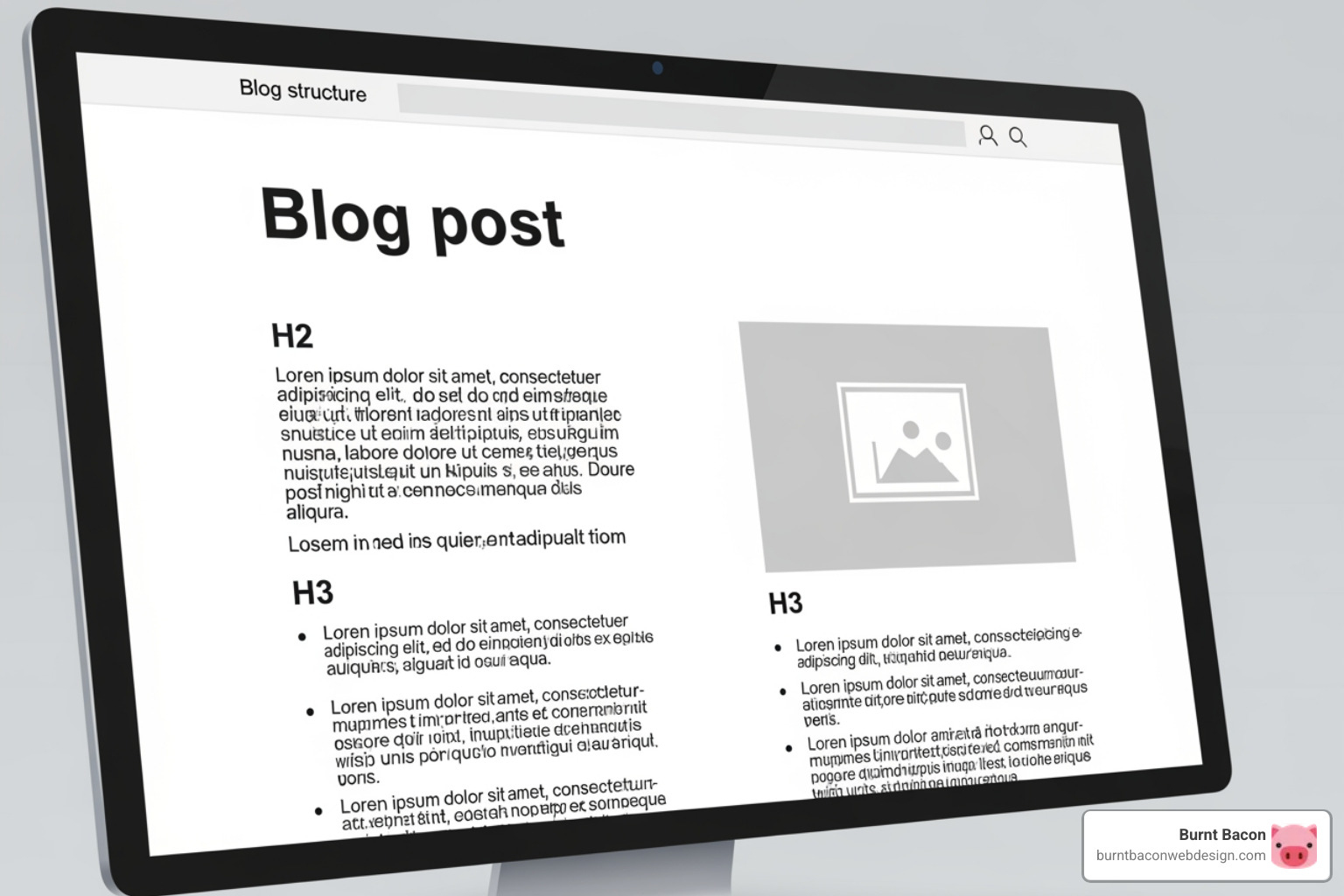
- Headings create a skeleton. Your H1 is your main title. H2s break content into major sections, while H3s and beyond subdivide them. This hierarchy helps readers scan and helps Google understand your content’s organization.
- Keep paragraphs short. We aim for 2-3 sentences maximum. Walls of text are intimidating; short paragraphs create breathing room and make reading less intimidating.
- Use strategic bolding. Bolding highlights key points for scanners, helping them grasp main ideas without reading every word. Just don’t overdo it.
- Use lists. Bullet points and numbered lists are perfect for breaking down steps or complex information. They’re scannable, digestible, and readers love them.
Readability Best Practices:
- Use short paragraphs (no more than three sentences)
- Left-align text for comfortable reading
- Keep sentence structures simple and direct
- Ensure strong color contrast between text and background
- Break up long sentences into shorter ones
- Avoid jargon, or explain technical terms clearly when necessary
Optimizing On-Page Elements
These elements are your storefront in search results, your first impression with visitors from Utah and beyond. Getting them right is crucial for attracting clicks from your target Salt Lake City audience.
- Your meta title is your headline in Google. It needs your primary keyword (ideally near the beginning) and must be compelling enough to earn the click, all within 55-60 characters.
- Meta descriptions are your elevator pitch. While not a direct ranking factor, a good one brings more clicks. We write unique, informative descriptions (under 155 characters) with a clear call to action.
- Short, descriptive URLs make a big difference. Brian Dean’s research found that short URLs rank higher in Google. For example,
craigflick2.wpendgame.com/seo-content-writingtells users and search engines what to expect. We keep them clean and clear.
For a deeper dive, check out our guide on SEO Best Practices.
The Role of Multimedia and Visuals
Multimedia isn’t just decoration; it keeps people engaged and signals value to search engines. For a local Utah business, showing photos of your work or team can build immediate trust.
- Images break up text and illustrate points. Optimizing them is essential, as Google Images is a huge source of traffic.
- Videos increase “dwell time,” which tells Google your content is valuable.
- Infographics turn complex data into shareable visual stories.
Proper optimization is key. Alt text describes images for accessibility and SEO. Descriptive file names (e.g., seo-content-writing-guide.jpg) provide context. File size impacts page speed, a critical SEO factor. We compress every image to load fast without sacrificing quality. If your site is slow, check out our Website Speed Optimization Services.
Amplifying Your Reach: Links, Promotion, and Authority
Creating brilliant SEO content writing is only half the battle. You also need to build roads to it. Linking strategies and content promotion are essential for amplifying your reach and establishing your authority with your Utah audience.

This is where linking and promotion come into play. Internal links guide visitors through your site, while external links boost your credibility. Strategic promotion then ensures your content reaches the right people in the Salt Lake Valley, driving local traffic and building your presence.
Mastering Internal and External Linking
Links are the highways of the internet. Using them strategically can transform your results.
Internal links connect pages on your site, creating a seamless user journey and showing Google the depth of your expertise. They distribute “link equity” (ranking power) throughout your site. We use descriptive anchor text with relevant keywords, not generic phrases like “click here.”
External links to reputable sites strengthen your content. By backing up your claims with authoritative sources, you demonstrate E-E-A-T and show both readers and Google your information is trustworthy. This can even help improve your rankings. For businesses across Salt Lake City and Provo, a smart linking strategy is vital. Learn more in our guide on High Traffic Link Building Utah.
Optimizing for Featured Snippets and AI Overviews
Ever see the answer boxes at the top of Google? That’s a featured snippet, or “position zero.” Landing there, or in Google’s AI Overviews, is a huge visibility boost for a South Jordan business trying to stand out.
To optimize your SEO content writing for these spots, we answer questions directly and clearly, often near the top of the content. We use “how-to” formats, numbered lists, and powerful FAQ sections. For example, a Salt Lake City plumber might create a list answering, “How to prevent frozen pipes in a Utah winter?” We also implement structured data (like FAQPage schema markup) to help search engines understand your content.
The topic cluster strategy also works well: create a comprehensive “pillar page” on a broad subject and link it to supporting articles on subtopics. This demonstrates authority, which Google loves. HubSpot has an excellent guide to topic clusters if you want to learn more.
The Role of AI, Content Updates, and Promotion
The digital landscape, especially with AI search, is always changing. AI can be a powerful writing assistant for brainstorming or outlining, but it should assist, not replace, human expertise. Your real-world experience as a Utah business owner is your unique asset that AI cannot replicate.
Content freshness also matters. We regularly update older articles with new stats and links to signal relevance. Finally, promotion is key. We strategically share content on social media, in email newsletters, and through outreach to build backlinks. We also repurpose content—turning a blog post into an infographic or video—to maximize its reach across different channels.
Frequently Asked Questions about SEO Content Writing
We talk with business owners across Salt Lake City and Utah every week, and certain questions about SEO content writing come up again and again. Here are the answers to the most common ones.
What is the main difference between SEO writing and regular content writing?
SEO content writing is designed to serve both human readers and search engines. While regular content writing focuses on engagement and information, SEO writing adds a strategic layer of keyword research, on-page optimization, and a search-friendly structure. For a Utah business, this means creating a blog post about “best ski resorts near Salt Lake City” that is both a great read and optimized to appear when someone searches for that term.
Is keyword density still an important ranking factor?
No. The idea of a “magic” keyword percentage is outdated. Modern search engines understand context and semantic relationships, rewarding content that covers a topic comprehensively and naturally. In fact, Google has explicitly stated they don’t pay attention to keyword density. Overusing keywords (keyword stuffing) can actually harm your rankings. Focus on writing for your South Jordan customers first, not a formula.
How can I measure the success of my SEO content?
Success isn’t just about ranking #1. We measure if content is working for your business using tools like Google Analytics and Search Console. Key metrics include:
- Organic traffic: How many people from the Salt Lake City area find you via search.
- Keyword rankings: Your position for local terms like “plumber in South Jordan.”
- Click-through rate (CTR): How many people click your link in search results.
- Time on page & Bounce rate: How engaged visitors are.
- Conversions: The ultimate goal—form submissions, calls from local numbers, or sales.
These metrics show the return on your content investment. For our Utah clients, we track these closely and optimize content that isn’t performing.
Conclusion: Start Crafting Content That Converts
We’ve covered the essentials of SEO content writing, from search intent and keywords to structure and linking. The good news is you don’t need to be a tech wizard to succeed. The core principle is simple: create genuinely helpful content that answers real questions for real people in your South Jordan neighborhood or across the Wasatch Front.
SEO content writing is an ongoing journey, especially in a growing market like Salt Lake City. Search algorithms evolve, AI is changing how people find information, and your audience’s needs shift. But this means there’s always room to improve and connect more deeply with your local customers.
The Utah businesses we work with in Salt Lake City and South Jordan want to be found, trusted, and chosen locally. Smart SEO content writing delivers just that. It’s about becoming the go-to resource in your field, building relationships, and turning searchers into loyal clients.
Your experience matters. When you share that through well-crafted, optimized content, you create a powerful bridge between what people need and what you offer.
At Burnt Bacon Web Design, we’ve spent over a decade helping Utah businesses like yours make that connection. We know the local landscape and genuinely care about seeing you succeed. From comprehensive Local SEO Salt Lake City strategies to ongoing content support, we’re here to be your partner.
So, what’s your next step? Start with one piece of content. Answer one question your customers always ask. Apply what you’ve learned here, and build from there. And if you need a hand—or want someone to handle it all while you run your business—we’d love to chat. Let’s create content that doesn’t just rank, but truly converts.