
Why Local SEO is a Game-Changer for Utah Businesses
If you’re a Utah business owner looking to improve local ranking and attract more customers from your community, you’re in the right place. Local SEO helps your business appear prominently when nearby customers search for your products or services on Google and Google Maps.
Quick Answer: To improve local ranking, focus on these proven strategies:
- Optimize your Google Business Profile – Complete every section, choose accurate categories, and maintain consistent business information
- Build NAP consistency – Ensure your Name, Address, and Phone number are identical across all online directories
- Generate positive reviews – Actively request reviews from satisfied customers and respond to all feedback
- Create location-specific content – Add local keywords to your website and create pages targeting specific Utah neighborhoods
- Earn local backlinks – Get links from local chambers of commerce, news outlets, and community organizations
- Implement technical SEO – Ensure your site is mobile-friendly, fast-loading, and uses local business schema markup
Why this matters for your business:
- 46% of all Google searches have local intent
- 88% of consumers who conduct a local search visit a related store within one week
- The top 3 Google Maps listings receive nearly 75% of all clicks for local searches
The stakes are high. When potential customers in Salt Lake City, Provo, or Ogden search for services like yours, you need to appear in the coveted “Local 3-Pack” – those three businesses that appear with a map at the top of search results. This prime real estate can be the difference between a thriving business and one that remains invisible to your community.
Local SEO is different from traditional SEO. Google’s algorithm uses three core pillars to determine local rankings: proximity (how close you are to the searcher), relevance (how well your business matches their search), and prominence (how well-known and trusted your business is). Understanding and optimizing for these factors is essential for any Utah business that wants to compete in today’s digital marketplace.
I’m Craig Flickinger from Burnt Bacon Web Design, and over the past 10+ years working with Utah businesses, I’ve helped countless companies improve local ranking and dominate their local markets through strategic SEO. My team and I specialize in helping businesses throughout the Salt Lake City area transform their online presence and capture the customers searching for them right now.
Understanding Google’s Local Algorithm: The Three Pillars of Ranking
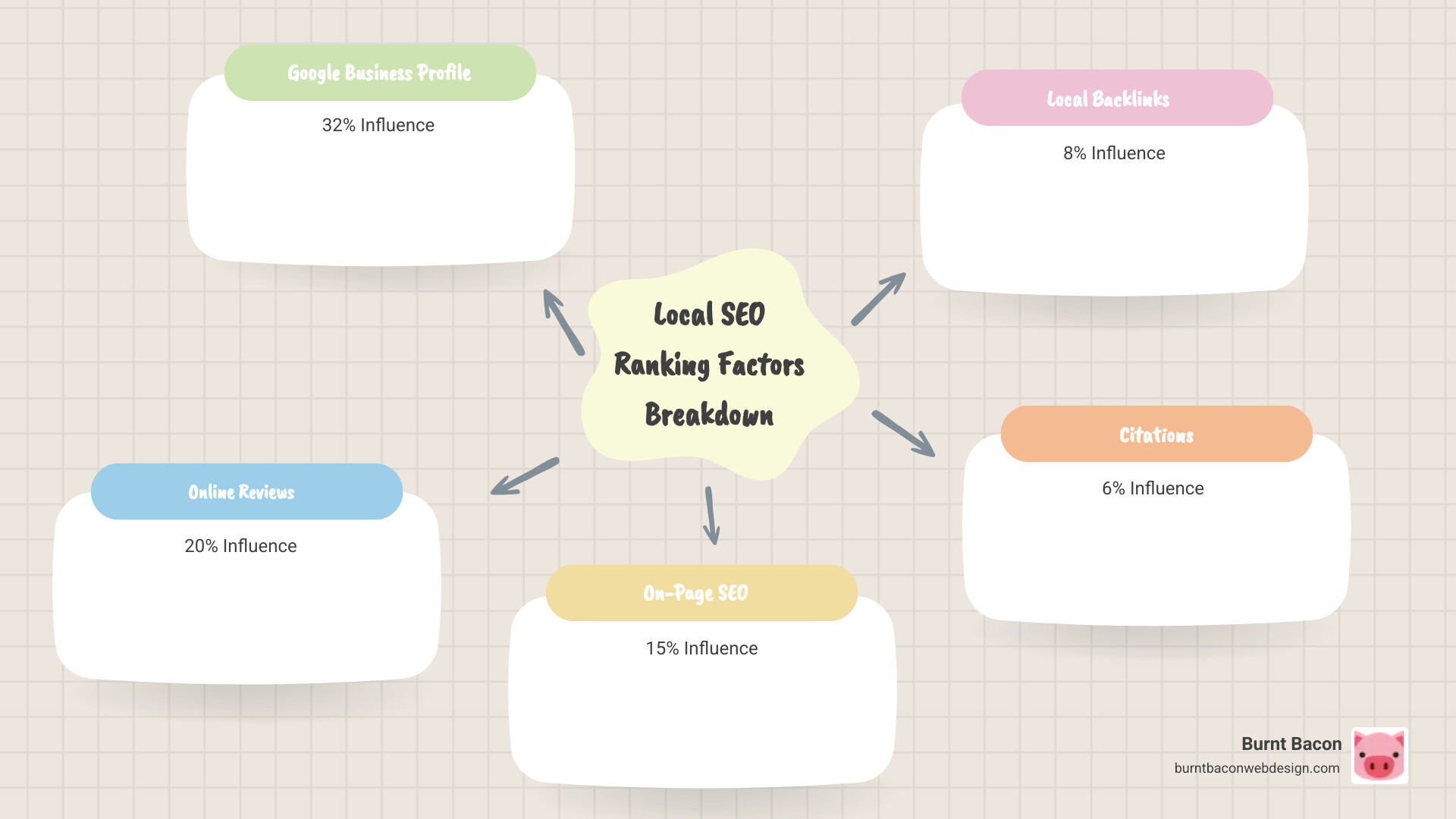
Google’s local algorithm isn’t a mystical force; it’s built on a foundation of logic designed to connect searchers with the most relevant local businesses. Google itself highlights three core pillars that determine which businesses appear at the top of local search results: Proximity, Relevance, and Prominence. Understanding these factors is the first step toward improving your visibility and helping your Utah business shine.
Furthermore, the landscape of search is always evolving. Recent data from the 2026 Local Search Ranking Factors survey indicates that AI search visibility factors are now significantly impacting local SEO strategies. While traditional factors still hold weight, AI-driven results emphasize strong on-page optimization, reviews, and citations. This means that many of the core SEO practices we’ll discuss are not just for humans but for intelligent algorithms too! There are more than 180 possible local ranking factors, but not all carry equal weight. We’ll focus on the most impactful ones to help your business improve local ranking.
Proximity: Being Close to Your Customers
Imagine someone in South Jordan, Utah, searching for “coffee shop near me.” Google’s primary goal is to show them the closest and best options. This is the essence of proximity. Google uses the searcher’s current location (if shared) or the location specified in their query (e.g., “coffee shop Salt Lake City”) to determine how physically close your business is.
For businesses with a physical storefront in Salt Lake City or South Jordan, ensuring your exact address is accurately listed across all platforms is paramount. For service-area businesses (SABs) like plumbers serving Salt Lake County or landscapers who travel to customers’ locations across the Wasatch Front, you can define your service area (cities, postal codes, or counties you serve) in your Google Business Profile. This allows you to rank on Google Maps even without a physical storefront at every customer’s doorstep. Geotargeting, or making sure your website and listings signal the specific areas you serve—from South Jordan to Salt Lake City—is crucial for these “near me” searches.
Relevance: Matching the Searcher’s Need
Once Google knows where the searcher is, it tries to figure out what they actually need. This is where relevance comes in. How well does your business listing match the user’s search query?
To maximize your relevance, keywords are vital. Ensure your Google Business Profile (GBP) accurately describes your services. For instance, if you’re a web design agency in Utah, use keywords like “web design Salt Lake City” or “SEO South Jordan” in your profile and website content. Your primary category in GBP is the top factor influencing rankings in Google’s Local Pack, so choose it carefully. Adding relevant additional categories can also expand your reach; businesses using four additional categories within their GBPs have the highest average map ranking of 5.9.
Beyond GBP, your website’s on-page content needs to reflect your services and locations. User-generated content, such as reviews that mention specific services or products, also contributes to relevance. By understanding the search intent behind a query (e.g., someone searching for “Italian restaurant” is likely looking to dine out soon), you can tailor your content to directly address their needs.
Prominence: Building Your Local Authority
Prominence refers to how well-known and established your business is, both offline and online. Google wants to recommend businesses that are reputable and trusted.
One of the biggest drivers of prominence is online reviews. Reviews are now the second most important factor for Local Pack and AI ranking. A steady stream of positive reviews tells Google (and potential customers) that your business is reliable and provides good service. We’ll dig deeper into managing reviews shortly.
Backlinks from local sources also build prominence. When other reputable Utah-based websites (like local news sites, community blogs, or chambers of commerce) link to your website, it signals to Google that your business is an authority in its field. Similarly, local citations—mentions of your business’s Name, Address, and Phone Number (NAP) on other websites like KSL.com Classifieds or local Utah business directories—contribute to your online footprint. Businesses with consistent NAP data across major citation sources are 40% more likely to appear in the local pack. Finally, general brand mentions and active community engagement within Utah, whether through sponsorships or local partnerships, can further improve your prominence.
Your Foundation: A Perfectly Optimized Google Business Profile (GBP)
Your Google Business Profile (GBP) is arguably the most critical tool for local SEO. Think of it as your digital storefront on Google Search and Maps. A well-optimized GBP can significantly improve local ranking and is considered a top ranking factor, especially for the local 3-pack.
The journey to local ranking success starts with claiming and fully verifying your GBP. This tells Google you’re a legitimate business and gives you control over the information displayed. Accuracy is key here; inconsistent or incomplete information can confuse both Google and potential customers, hindering your local visibility. For a comprehensive guide on setting this up, check out our Google My Business Optimization Guide.
Core Profile Optimization
Let’s explore the specifics of making your GBP shine:
- Consistent Business Name: Use your exact, legal business name. Avoid keyword stuffing your business name with locations or services, as this can violate Google’s guidelines and negatively impact your ranking.
- Primary & Secondary Categories: As mentioned, your primary category is incredibly important. Choose the most accurate category that describes your main business function. Then, add secondary categories that cover all other relevant services you offer. For example, a web design agency in Salt Lake City might have “Web Designer” as primary and “SEO Consultant” and “Digital Marketing Agency” as secondary.
- Address vs. Service Area: If you have a physical location in Salt Lake City or South Jordan where customers visit, list your full address. If you’re a service-area business (e.g., a mobile car detailer in Utah), you can hide your address and specify the cities or regions you serve.
- Local Phone Number: Use a local Utah area code (e.g., 801, 385) rather than a toll-free number. This reinforces your local presence to Google.
- Website URL: Link to your main website. If you have location-specific pages (which we’ll discuss later), link to the most relevant one.
- Business Hours: Keep your regular and special holiday hours carefully updated. Nothing frustrates a potential customer more than showing up to a closed business.
Engaging with Customers and Managing Reviews
Online reviews are a goldmine for local SEO. They act as social proof, build trust, and are a significant ranking factor. Reviews are now the second most important factor for Local Pack and AI ranking.
- Review Generation Strategy: Don’t just wait for reviews; actively encourage them! Make it easy for satisfied customers in Utah to leave feedback. You can provide a direct link to your Google review page via email, text, or even a QR code in your physical location.
- Responding to All Reviews: This is crucial. Respond to every review, positive or negative. For positive reviews, thank the customer and reiterate your services. For negative reviews, respond professionally, empathetically, and offer to resolve the issue offline. 92% of consumers now consider business owner responses to reviews to be part of providing high-quality, modern customer service. This demonstrates your commitment to customer satisfaction. For more on this, see our guide on How to Manage Reputation.
- Review Quantity and Quality: Google considers the quantity, quality, and recency of reviews. Aim for a steady stream of new, positive reviews.
- GBP Q&A and Posts: Use the Q&A section on your GBP to answer common questions proactively. Regularly post updates, offers, and events (e.g., a special promotion for our Salt Lake City clients, or a workshop in South Jordan) to keep your profile active and engaging.
Showcasing Your Business with Photos and Products
Visuals are powerful. Businesses with more photos get more customer engagement and tend to rank higher.
- High-Quality Photos: Upload numerous high-quality photos of your business exterior, interior, products, services, and team. Show off your unique Utah personality!
- Geo-tagged Images: While the impact of geo-tagging photos is debated, it doesn’t hurt to have them. Some tools allow you to embed location data into your image files.
- Videos: Short, engaging videos can also be uploaded to your GBP to give customers a better feel for your business.
- Product Listings & Services Menu: If applicable, add your products or a detailed services menu to your GBP. This provides more information to potential customers and signals greater relevance to Google.
Mastering On-Page and Off-Page SEO to Improve Local Ranking
Beyond your Google Business Profile, your website plays a critical role in local SEO. On-page SEO involves optimizing elements directly on your website, while off-page SEO focuses on activities outside your website to build authority and trust. Together, these strategies work to improve local ranking. To learn more about this, explore our dedicated resource on SEO for Local Businesses.
Key On-Page Tactics to Improve Local Ranking
Your website is your digital home, and optimizing it for local search is non-negotiable.
- Local Keyword Research: This is your starting point. Think like your Utah customers. What terms would they use to find your business? Use tools like Google Keyword Planner, Ahrefs, or SEMrush to find local keywords. Look for both short-tail (e.g., “web design Salt Lake City”) and long-tail (e.g., “affordable Shopify development South Jordan”) keywords. Incorporate these naturally into your website content, title tags, meta descriptions, and headings.
- City-Specific Landing Pages: If your business serves multiple locations within Utah (e.g., Salt Lake City, South Jordan, Provo), create dedicated landing pages for each. Each page should have unique, localized content, specific NAP information (if applicable), and showcase services relevant to that particular area. This helps Google understand your service footprint.
- Mobile Optimization: Most local searches happen on smartphones. Google also uses mobile-first indexing, meaning it primarily uses the mobile version of your content for indexing and ranking. Your website must be mobile-friendly, responsive, and load quickly on mobile devices. Use tools like Google PageSpeed Insights to check your site’s performance.
- Localized Content Marketing: Create content that resonates with your local Utah audience. This could include blog posts about local events, community news, case studies featuring local businesses, or even guides on topics relevant to your Utah customers. For example, a landscaping company might write about “Best Drought-Resistant Plants for Utah Gardens.” This demonstrates local expertise and relevance. For help with content, check out our SEO Content Writing services.
- Creating Neighborhood Guides for Salt Lake City: Go a step further by creating detailed guides about specific neighborhoods within Salt Lake City or South Jordan. If you’re a restaurant, you could write “Top Brunch Spots in Sugar House.” This hyper-local content can attract highly targeted traffic.
Essential Off-Page Strategies: Citations and Backlinks
Off-page SEO signals to Google that your business is trustworthy and authoritative in its local market.
- NAP Consistency: We can’t stress this enough. Your Name, Address, and Phone Number must be identical across all online directories and listings. Inconsistent NAP information might confuse search engines and customers, lowering search ranks and reliability. Tools like BrightLocal or Yext can help manage and audit your NAP data. Businesses with consistent NAP data across major citation sources are 40% more likely to appear in the local pack.
- Local Citations: These are mentions of your business on other websites, even without a direct link. Think Yelp, Yellow Pages, industry-specific directories, and Utah-based sites like the Salt Lake Chamber or local city business listings. The more accurate citations you have, the more credible your business appears to Google. For a deeper dive, read our guide on Local Citations Building.
- Local Link Building Strategies: Backlinks from authoritative and locally relevant websites are like votes of confidence.
- Connect with other local businesses: Partner with complementary businesses in Utah for cross-promotion and potential link exchanges.
- Sponsoring Utah community events: Sponsoring local events (e.g., a charity run in Salt Lake City or a community festival in South Jordan) can earn you valuable links from event websites, news outlets, and participating organizations.
- Local PR: Pitch interesting stories about your business to local Utah news outlets like the Salt Lake Tribune, Deseret News, or KSL. If they feature you, that’s a powerful backlink.
- Guest Blogging: Offer to write guest posts for reputable, locally focused blogs or industry publications within Utah. This can drive referral traffic and build your authority.
- For advanced strategies, our White Hat SEO Link Building Utah services can help. A word of caution: bad backlinks can harm your site. Use tools like the MozBar Chrome extension to assess the quality of linking domains.
Advanced Technical SEO and Performance Tracking
Technical SEO might sound intimidating, but it ensures your website is easily findable, crawlable, and understandable by search engines. These underlying factors can significantly improve local ranking. Our Technical SEO Audit Complete Guide provides an in-depth look.
- Site Speed: A slow website frustrates users and negatively impacts rankings. Most local searches happen on mobile, and people want information now. Use tools like Google PageSpeed Insights, GTmetrix, or WebPageTest to identify bottlenecks and improve loading times. Compressing images, lazy loading, and using a Content Delivery Network (CDN) are common solutions.
- Mobile-First Indexing: As Google prioritizes the mobile version of your site, ensuring your website is fully responsive and offers a seamless experience on all devices is critical.
- Website Security (HTTPS): Google favors secure websites. Ensure your site uses HTTPS (indicated by a padlock icon in the browser bar), which encrypts data between your site and users.
Implementing Local Schema and Sitemaps
Structured data helps search engines understand the content on your pages more effectively, making you eligible for rich results in search.
- What is Schema markup: This is a vocabulary of tags (or microdata) that you can add to your HTML to improve the way search engines read and represent your page in SERPs. You can find official definitions at Schema.org.
- LocalBusiness Schema: Specifically for local businesses, this markup allows you to highlight essential details like your address, phone number, hours of operation, reviews, and services. Implementing this code helps search engines understand and show these details, potentially leading to higher click-through rates.
- Using Google’s Structured Data Markup Helper: You don’t need to be a coding expert. Tools like Google’s Structured Data Markup Helper can assist you in generating the necessary code. After adding it, validate your markup using Google’s Rich Results Test tool to ensure accuracy. Always adhere to Google’s structured data guidelines.
- XML Sitemaps for Location Pages: An XML sitemap lists all important pages on your website, helping search engines crawl and index them efficiently. If you have multiple location-specific pages (e.g., for Salt Lake City and South Jordan), ensure each is included in your sitemap. You can create one manually or use tools like Lucidchart. Submit your sitemap to Google Search Console.
Advanced Strategies to Improve Local Ranking and Track Performance
To truly improve local ranking and dominate your Utah market, continuous monitoring and adaptation are key.
- Geogrid Rank Tracking Tools: Geogrid tools (like Semrush’s Map Rank Tracker) show your ranking across a grid of locations, providing a much more accurate picture of your visibility in Salt Lake City, South Jordan, and surrounding areas. This helps you identify specific neighborhoods where you need to boost your presence.
- Analyzing GBP Insights: Your Google Business Profile dashboard provides valuable insights into how customers are finding your listing, their actions (calls, website clicks, direction requests), and how you compare to competitors. Regularly review these metrics.
- Google Analytics for Local Traffic: Set up Google Analytics to track traffic from local searches to your website. Monitor user behavior on your location-specific pages to understand what’s working and what isn’t.
- Common Local SEO Mistakes to Avoid:
- Keyword Stuffing: Avoid cramming your business name or descriptions with keywords. Google is smart and penalizes this.
- Fake Reviews: Never create or solicit fake reviews. This violates Google’s policies and can lead to severe penalties.
- Neglecting Negative Reviews: Ignoring negative feedback is a missed opportunity to show excellent customer service. Respond gracefully.
- Incomplete Profiles: A partially filled-out GBP looks unprofessional and signals less relevance to Google.
- Virtual Office Addresses: While SABs can hide their address, using a P.O. Box in downtown Salt Lake City or a virtual office address for a physical storefront business in South Jordan can be problematic and may violate Google’s guidelines.
- For more on tracking and refining your strategy, explore our article on how to Boost Rankings by Tracking Local SEO Performance.
Frequently Asked Questions about Local Rankings
Can my business rank on Google Maps without a physical storefront?
Yes, absolutely! Service-area businesses (SABs) that travel to their customers, like plumbers, electricians, or even mobile web designers in Utah, can rank on Google Maps. In your Google Business Profile, you can hide your physical address and instead define a specific service area by listing the cities, postal codes, or counties you serve (e.g., Salt Lake County, Utah County). This ensures you appear for relevant local searches within those regions.
What’s the difference between Google Maps rankings and ‘local finder’ rankings?
While closely related, there’s a subtle distinction. Google Maps rankings typically refer to the “Local 3-Pack” that appears directly in Google Search results or when you open Google Maps. These results heavily prioritize proximity to the searcher. “Local Finder” rankings, on the other hand, appear when a user clicks “More businesses” from the 3-Pack, expanding to a larger list of local businesses. While proximity is still important, the Local Finder often gives more weight to prominence and reputation (like review quantity and quality) for businesses that might be slightly further away—say, a highly-rated restaurant in South Jordan appearing for a Salt Lake City searcher—but are highly regarded.
How long does it take to see local SEO results?
The timeline for seeing local SEO results can vary based on several factors, including the competitiveness of your industry in Utah, the quality of your optimization efforts, and how consistently you implement strategies. Some quick wins, like fully optimizing your Google Business Profile, might show initial improvements within a few weeks. However, building significant authority through consistent reviews, local citations, and backlinks is an ongoing process that can take several months (3-6 months or more) to yield substantial and sustainable results. Patience and consistency are key to long-term success.
Conclusion: Dominate Your Local Market in Salt Lake City
Improving your local ranking isn’t a one-time task; it’s an ongoing journey that requires dedication and a strategic approach. By focusing on Google’s three core pillars—Proximity, Relevance, and Prominence—and diligently optimizing your Google Business Profile, website, and off-page signals, your Utah business can significantly improve local ranking and capture the attention of local customers.
We’ve covered a lot: from understanding Google’s algorithm and optimizing your GBP, to mastering on-page and off-page SEO, and delving into technical aspects like schema markup and performance tracking. The key takeaway is consistency. Regularly updating your GBP, actively soliciting and responding to reviews, producing localized content, and building local connections will compound over time, leading to greater visibility and more customers walking through your doors or visiting your website.
At Burnt Bacon Web Design, we understand the unique challenges and opportunities for businesses in Salt Lake City, South Jordan, and across Utah. With over a decade of experience, our team is equipped to help you steer this complex landscape. We don’t just build websites; we craft comprehensive digital strategies designed to help you thrive locally.
Ready to take your local presence to the next level? Get your free audit and start improving your local ranking in Salt Lake City today!